The Weight in the Chest
There is a specific weight shame has in the chest. Not sharp like fear. Not hollow like grief. Dense. Settled. The kind of thing you stop noticing because it has been there so long it starts to feel like your natural resting state.
Most people who carry it do not call it shame. They call it realism. They call it self-awareness. They call it the thing that keeps them humble. They experience it as a low-grade certainty that underneath the performance, underneath the title, underneath everything they have built, there is something that does not quite deserve to exist.
That certainty does not announce itself as a feeling. It announces itself as a fact. And that is what makes it so structurally dangerous. Fear says something bad might happen. Grief says something bad already happened. Shame says something bad is you.
The person searching for why they keep getting stuck, why the loop keeps resetting, why insight never seems to translate into lasting change, will find the answer here. Not in the trigger. Not in the pattern. Not in the borrowed safety or the identity strategy or the relational template. All of those are structural components. Shame is the enforcement mechanism that keeps every one of them locked in place.
Shame Is Not a Feeling. It Is an Enforcement Mechanism.
The Attachment in Motion Model locates shame at Stage 6 of the Containment Loop. Not at the beginning. Not at the end. At the exact structural position where it can do the most architectural damage: between the cost of the survival strategy and the recommitment to it.
Here is how the loop runs. A trigger activates the nervous system. The body deploys its survival strategy. Borrowed regulation provides temporary relief. The cost arrives. Exhaustion, disconnection, the creeping awareness that the person has abandoned themselves again in order to maintain the scaffold. And then, in the gap between cost and recommitment, shame steps in.
Not as a drifting emotion. As a system of enforcement.
It does not suggest that the strategy has expired. It suggests that the person has. You are weak. You are ungrateful. You are defective. Shame personalizes survival. It takes a physiological response and fuses it to identity. The moment the person turns on themselves, investigation stops. Prosecution begins.
As long as you are busy indicting your character, you will not examine the architecture that required the scaffold in the first place.
That is not a side effect. That is the function. Shame does not merely punish. It protects the loop from examination by redirecting all available attention toward self-attack. While the person is consumed with what is wrong with them, they cannot see what is wrong with the system they are operating inside. The architecture remains invisible. The loop resets. Stage 7, recommitment, follows with the reliability of a metronome.
Before Shame Was a Feeling, It Was a Strategy
Shame did not start as punishment. It started as protection.
In the early environment, the people the child depended on were unstable, unsafe, or simply unavailable. The child's nervous system faced a problem it could not solve through action. It could not leave. It could not negotiate. It could not file a complaint with the management. It was a small body dependent on large bodies that were not behaving the way the child needed them to behave.
And the body made a choice. It chose to be the problem.
Not because the child was weak. Because it was safer. If I am bad, the world is still predictable. If I am the failure, the people I need are still okay. Shame preserved attachment by absorbing the blame. The child who decides the problem is them can still maintain the illusion that the caregivers are safe. The child who accurately perceives the caregivers as the problem has nowhere to turn.
That is a brilliant calculation by a body that cannot afford to lose its primary attachment. It is also the moment shame gets installed as infrastructure rather than emotion. Not something the person feels occasionally. Something the person operates from permanently.
And it kept the person inside it by protecting them from something harder. Grief.
Grief is helpless. It has no action step. It cannot be redeemed through output or resolved through effort. It can only be felt and survived. Shame offered something grief could not: a verdict with a solution attached. If the problem was moral failure, the answer was always available. Try harder. Sacrifice more. Redeem yourself through performance.
Punishment felt like control. Grief felt like drowning.
That is why shame persists long after the original environment has changed. It is not because the person enjoys suffering. It is because the alternative to shame is grief, and grief requires tolerating helplessness, and helplessness is the one thing the survival architecture was specifically designed to avoid.
How Shame Collapses Physiology into Character
Shame has a specific operational signature. It speaks quickly. It speaks with great confidence. And it compresses something complicated into a verdict.
You are not overwhelmed. You are weak. You are not exhausted. You are lazy. You are not grieving. You failed.
That compression is the mechanism. The person experiences a physiological state, a state that has structural causes, a state that makes perfect sense given the architecture they are operating inside, and shame collapses the entire complexity into a character judgment. The body's legitimate protest becomes evidence of personal deficiency.
This is why the person keeps getting stuck at the same point in the healing process. They reach the moment of cost. They feel the exhaustion of maintaining the borrowed safety. They sense the gap between the strategy and who they actually are. And instead of investigating that gap, shame arrives and converts it into self-prosecution.
The investigation never happens. The architecture remains intact. The loop resets.
Every identity pattern in the Attachment in Motion Model has its own version of this collapse. The Fixer who burns out does not see burnout as a signal that the strategy has exceeded its structural limits. Shame says the burnout proves they did not fix hard enough. The Performer who crashes does not see the crash as the body's refusal to sustain an unsustainable pace. Shame says the crash proves they are not as capable as they pretended to be. The Pleaser who finally reaches the edge of resentment does not see the resentment as a legitimate signal from a self that has been systematically overridden. Shame says the resentment proves they are selfish.
In every case, the signal that could lead to structural change gets intercepted by shame and converted into fuel for the next revolution of the loop. The person does not exit. They recommit. With more intensity. With more determination. With the particular desperation of someone who believes the problem is their insufficient effort rather than the architecture that demands it.
The Containment Loop with Shame as the Lock
Stage 1 - Trigger: Something in the present brushes against an older imprint. A shift in tone. A silence that thickens the room. A criticism that carries more weight than its words. The body registers threat. Not to comfort. To belonging.
Stage 2 - Reach: The person reaches for borrowed regulation. The scaffold. The role. The relationship. The structure that has historically provided the experience of being okay. The reach is not chosen. It is activated.
Stage 3 - Label: The nervous system labels the disruption through the lens of the original template. The partner's silence becomes abandonment. The manager's feedback becomes rejection. The label is not about the current situation. It is the original wound speaking in the present tense.
Stage 4 - Fix: The identity pattern deploys. The Fixer solves. The Performer escalates. The Pleaser accommodates. The Ghost disappears. The strategy is aimed at restoring borrowed regulation, not at addressing the actual dynamic.
Stage 5 - False Relief: The scaffold holds. The noise quiets. The person mistakes the settling for resolution. Nothing structural has changed. The regulatory supply has been temporarily restored.
Stage 6 - Shame: This is the lock. The cost arrives. The person sees what they did. They feel the familiar weight of having abandoned themselves to chase regulation from an external source. And shame steps in with its standard indictment. You did it again. You knew better. Something is fundamentally broken in you. Shame does not suggest the strategy is outdated. It suggests the person is defective. Investigation stops. Self-attack begins. The architecture is protected from examination.
Stage 7 - Recommitment: The person resolves to be different. To stop chasing. To hold their ground. The recommitment is sincere. It is also the last stage of the loop. Shame has done its job. The person has not examined the architecture. They have examined themselves and found themselves wanting. The next trigger is already approaching.
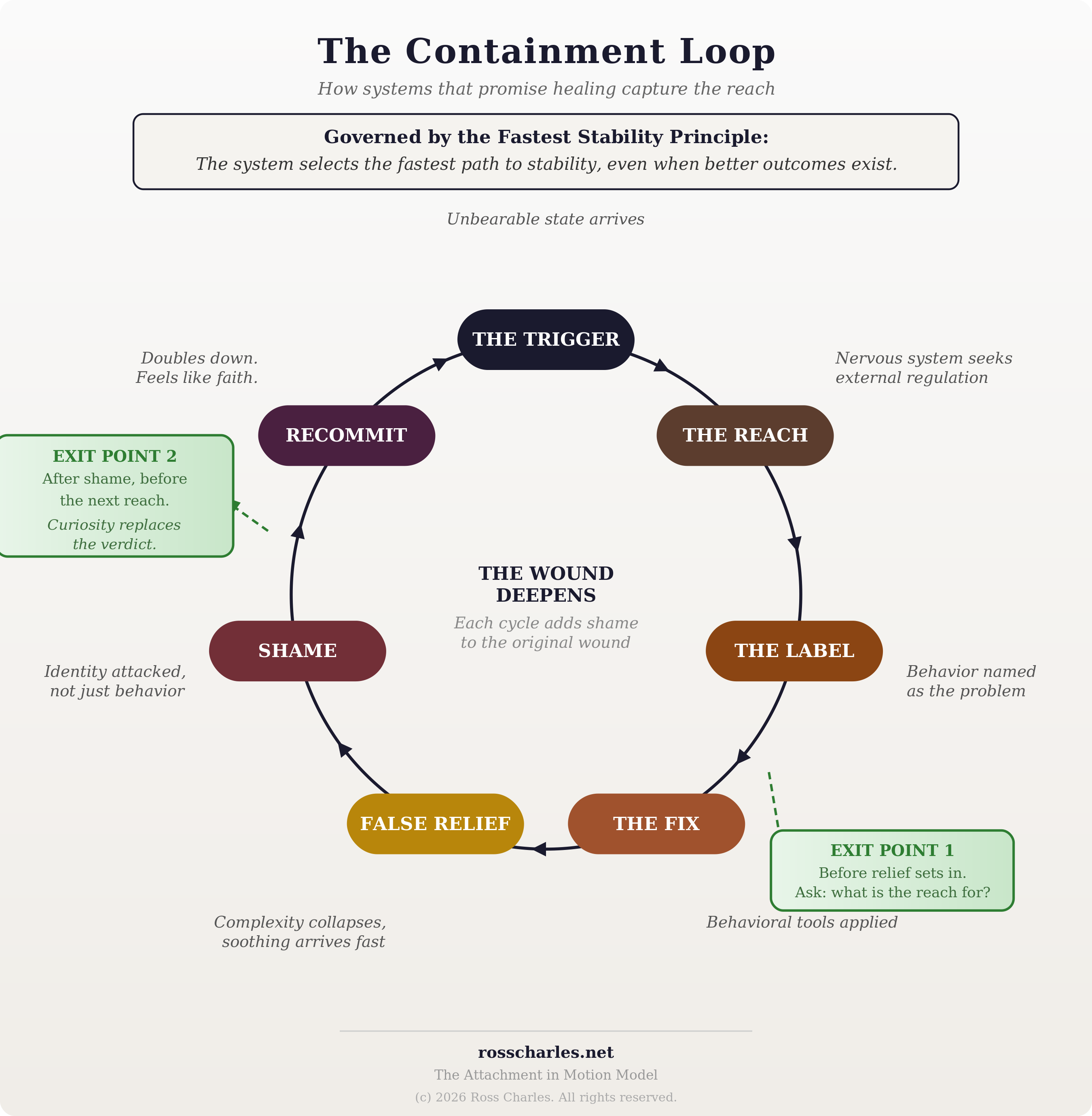
The Containment Loop. Shame occupies Stage 6, the structural position between cost and recommitment. It converts the signal that could lead to exit into fuel for the next revolution.
Why Insight Does Not Intimidate Shame
The person who has done the work, who has read the books, who has mapped their attachment style and identified their patterns and can narrate the loop in real time, will still get stuck here. Because shame does not operate at the level of insight. It operates at the level of the nervous system.
Shame is older than your explanations.
It was installed before language. It was installed in the body, not in the mind. It fires faster than conscious thought. By the time the prefrontal cortex has registered the cost and begun to formulate an alternative response, shame has already delivered its verdict, and the body has already begun organizing around it.
This is why the person can understand the pattern completely and still be unable to interrupt it. Understanding operates at one level of the system. Shame operates at another. And the level where shame operates does not accept input from the level where understanding lives.
Insight can observe shame. It cannot overrule it. The person can watch the shame arrive, can name it, can describe its function, can explain to their therapist exactly what is happening in their nervous system, and still feel the verdict land with full force. Because naming a program does not stop it from executing. It only means you can see it running.
Seeing a program run is not the same thing as having access to the console where it was written. The template was written in the limbic system and the brainstem, where survival architecture lives. Insight does not have administrative privileges at that level. It can observe the output. It cannot modify the code.
This is the structural limit of awareness-based approaches to shame. They make the pattern visible. They do not make it optional. The person who can see the loop is in a better position than the person who cannot. But visibility alone does not provide the exit. The exit requires something that reaches the same depth where shame was installed.
Shame Keeps You Loyal
There is a deeper function shame serves that is rarely discussed. Shame does not merely punish. It keeps you loyal.
Loyal to the identity pattern that was built for survival. Loyal to the borrowed safety that has been sourcing your regulation. Loyal to the system, the family, the relationship, the role, the belief structure that the survival architecture organized around.
Without the role, who are you? Beneath that question lives the deeper fear. Not embarrassment. Erasure. If I stop performing, I disappear. If I stop believing, I am cast out. If I stop achieving, I will starve. If I stop fixing, no one will need me. If I stop pleasing, no one will stay.
Shame says: I am wrong. Fear says: I will not survive. That is why the loop feels like life or death. Because once, it was. The child who stopped performing lost the attachment. The child who stopped pleasing lost the safety. The child who expressed need was met with withdrawal or punishment. The survival architecture was not theoretical. It was tested against real consequences. And shame was the mechanism that kept the child inside the strategy that kept the child alive.
In adulthood, the consequences have changed. The person is no longer a child dependent on caregivers who require performance in exchange for attachment. But the shame does not know that. It is still running the original calculation. Still enforcing loyalty to the original strategy. Still converting every signal that says this is no longer working into evidence that the person needs to work harder at making it work.
That is why leaving a harmful pattern does not feel like liberation. It feels like betrayal. The body experiences the departure from the survival strategy as the thing the survival strategy was designed to prevent: abandonment, exile, annihilation. Shame is the voice that says going back is the only safe option, even when the person can see that going back is the thing that is destroying them.
What Shame Protects You From
Shame protects you from grief.
That sentence is the structural key to this entire pattern.
Grief requires the acknowledgment that something was lost that cannot be recovered through effort. That the original environment did not provide what was needed. That the caregivers, however well-intentioned, did not teach the body how to regulate itself. That the child adapted because the child had to, and the adaptation cost something real, and no amount of future performance will retroactively fill the gap.
Shame says: the gap is your fault. Fix it. Grief says: the gap exists, and it hurts, and you did not cause it, and you cannot fix it by trying harder.
For a nervous system that was organized around effort as the primary survival strategy, grief is structurally terrifying. Grief has no action step. It cannot be resolved through output. It cannot be converted into a project. It can only be felt.
And feeling it means feeling the helplessness that the entire survival architecture was built to avoid.
This is why shame is so tenacious. It is not just punishing the person. It is protecting them from the one experience that would actually allow the architecture to shift. Grief is the doorway. Shame is the lock. As long as shame is running, the person will keep converting the signal into self-attack rather than allowing the grief to surface.
Shame accelerates. Grief slows. Shame protects the structure. Grief tells the truth about it. Shame says move on, get over it, be stronger, recommit. Grief says that hurt, and it mattered.
For many people, grief is the first act of loyalty toward themselves they have ever performed. It is the moment they stop defending the architecture and start telling the truth about what it cost.
What Actually Disrupts Shame
If shame was installed through lived experience at the level of the nervous system, it can only be disrupted through lived experience at the level of the nervous system. Not through argument. Not through affirmation. Not through understanding alone.
The Question That Creates Separation
Shame survives in blur. It fires verdicts before context can appear. It speaks so quickly and with such confidence that the person does not distinguish between the voice and themselves. The verdict feels like truth because there is no space between the voice and the identity.
The first disruption is a question. Not a rebuttal. A question.
Who is saying this?
That question creates a small but powerful separation. Until that moment, shame feels like truth. Once you ask who is speaking, it becomes something else. A narrator. And once you can see the narrator, another question follows.
To what end? Where is this voice trying to send me?
Every time the person asks those questions, the answer will be the same. More of the same. More of the survival strategy. More performance. More effort. More borrowed regulation. Shame is not trying to heal the person. Shame is trying to keep the old system running.
Experiencing the Mismatch
The template that drives shame changes when the body makes a prediction and the prediction is contradicted while the body is activated. The body predicts that expressing need will produce punishment. The person expresses need and is met with care. The body predicts that slowing down will produce abandonment. The person slows down and the relationship deepens. The body predicts that imperfection will cost the attachment. The person is imperfect and the attachment holds.
Each mismatch, experienced while the old alarm is firing, weakens the forecast. Not through argument. Through contradiction. The shame template does not respond to what you know. It responds to what happens while you are afraid it will happen differently.
Allowing Grief
The deepest disruption of shame is the grief it was designed to prevent. When the person stops converting the signal into self-attack and instead allows the loss to surface, the loop loses its lock. The grief does not feel good. It feels terrible. It feels like the drowning that shame was built to prevent. But grief, unlike shame, has a bottom. You can reach it. You can touch it. You can come back.
Shame is infinite. It never resolves because it was never designed to resolve. It was designed to loop. Grief is finite. It runs and it completes. And when it completes, something else becomes available. Not the absence of pain. The presence of a self that was previously occupied by the mechanism that was preventing this exact moment from arriving.
Building Layer 0: Self-Attachment
The foundational shift occurs when the person stops sourcing their worth from external verdicts and begins building the capacity to remain present with themselves when shame fires. This is Layer 0 of the Attachment in Motion Model: Self-Attachment. Not self-esteem, which is a cognitive evaluation. Self-attachment, which is a physiological capacity. The ability to stay in your own body when the internal narrator says leave yourself.
Self-attachment does not eliminate shame. It provides an alternative ground. The person still hears the verdict. They still feel the weight in the chest. But they have somewhere else to stand. They are no longer dependent on the verdict for their sense of reality. They can hear the voice, recognize the narrator, and choose not to kneel.
That is not rebellion. That is integration.
The Loop Can Lose Its Lock
The person who has been stuck in the Containment Loop, who has watched themselves repeat the pattern despite understanding it, who has felt the particular cruelty of seeing the architecture and being unable to exit it, is not broken. They are operating inside a system that was designed to be inescapable. Shame is the lock. And the lock was installed by a child who needed the loop to keep running because the loop was all that stood between the child and the unbearable truth that the people they depended on could not provide what was needed.
That child deserved better infrastructure. The adult who inherited the architecture deserves to know that the lock can be picked. Not through willpower. Not through better affirmations. Not through understanding alone.
Through the slow, body-level work of asking who is speaking when shame fires. Through the accumulation of mismatches that contradict the old forecast. Through the grief that shame was built to prevent. Through the patient construction of Layer 0, which is the ability to remain present with yourself when every survival instinct says abandon yourself in favor of the scaffold.
Shame kept you loyal to a system that kept you alive. That loyalty made sense when you were small and the system was all you had. It does not have to be the organizing principle of your adult life.
The weight in the chest can shift. The verdict can lose its authority. And the loop that felt like destiny can become, finally, design. Design can be revised.
For the regulatory architecture that shame enforces, see Codependency Is Not a Personality Flaw. It Is a Regulatory Strategy.
For the identity patterns that shame keeps locked in place, see People-Pleasing Is Not Kindness. It Is a Surveillance System.
For why boundaries collapse inside these dynamics, see Why Boundaries Do Not Stick
For the personal, narrative companion to this work, read The Reach on Substack.