There is a version of this experience that almost no one talks about publicly. Not because it is shameful. Because the language for it has not existed until now.
The Word That Explains Everything and Changes Nothing
Codependency has become one of the most widely used words in modern psychology. It appears in bestselling books, therapy intake forms, Instagram infographics, and the quiet verdicts people deliver about themselves at 2 AM when they cannot figure out why they keep doing what they keep doing.
It sounds like an answer. It functions like a label. And for millions of people, it has become the explanation for why they over-give, over-function, abandon their own needs, and organize their entire lives around someone else's emotional weather.
The problem is not that the word is inaccurate. People who carry codependent patterns are not imagining them. The exhaustion is real. The self-erasure is real. The feeling of being unable to stop managing everyone else's experience while yours quietly deteriorates in the background is absolutely real.
The problem is that the word, as it is typically used, describes the symptom and calls it the diagnosis. It names the behavior without naming the architecture that produced it. It says what is happening without explaining why the nervous system chose it. And because the label stops short of the mechanism, the interventions that follow tend to stop short as well.
Set better boundaries. Stop people-pleasing. Learn to say no. Practice self-care.
These are behavioral prescriptions for a structural condition. They target the output of the system while leaving the operating system untouched. And when the behavioral tools fail, which they reliably do under sufficient activation, the person does not conclude the framework was incomplete. They conclude they are.
That conclusion is wrong. And it is expensive.
Where the Word Came From and What It Missed
Codependency entered popular language through the addiction recovery movement of the 1980s. Originally, it described a pattern observed in the partners and family members of alcoholics: people who organized their own behavior around managing the addict's instability. The codependent person suppressed their own needs, monitored the other person's emotional state with extraordinary precision, and derived their sense of safety from their ability to keep the system stable.
The observation was accurate. These patterns are real, and they are remarkably consistent across populations.
What the framework missed was the question beneath the pattern: why would a nervous system learn to do this?
The original codependency model treated the behavior as the problem. It assumed the person had developed a dysfunctional attachment style, usually in response to growing up in an alcoholic or otherwise unstable home, and the solution was to unlearn the behavior. Stop enabling. Stop rescuing. Stop making someone else's crisis your responsibility.
This is not wrong. But it is incomplete in a way that matters.
Because when a nervous system organizes itself around managing another person's state, it is not making a lifestyle choice. It is executing a survival strategy that was installed before conscious decision-making was available. The behavior is the visible layer. Underneath it is a regulatory architecture that learned, through repetition, that the safest way to exist in an unpredictable environment was to become indispensable to the people who controlled it.
That is not codependency as a character trait. That is codependency as a regulatory strategy. And the difference between those two framings changes everything about how the pattern can actually be interrupted.
What the Nervous System Actually Learned
Before a person had language for codependency, they had a body. And that body was making calculations about safety long before the prefrontal cortex came online.
The calculations are simple. A child's survival depends on the adults around them. If those adults are unstable, unpredictable, emotionally volatile, or simply absent, the child's nervous system faces a problem with no obvious solution: the people it depends on for survival are the same people generating the threat.
The body does not resolve this contradiction through philosophy. It resolves it through adaptation.
Some children learn to become invisible. Others learn to become impressive. Others learn to become useful. The strategy varies. What does not vary is the underlying equation: I will modify myself in whatever way reduces the threat from the people I cannot survive without.
For the child who later becomes what we call codependent, the adaptation looks like this: scan the emotional state of the people around you. Anticipate what they need before they express it. Deliver it before they have to ask. Suppress anything in yourself that might disrupt the stability you are working to maintain.
This is not generosity. It is not people-pleasing as a personality trait. It is a nervous system that discovered, through thousands of small repetitions, that the fastest path to safety was to become an extension of someone else's regulatory system.
The child learned to regulate the adults. Not because anyone asked them to. Because no one regulated the child. When no one comes, you adapt. You do not stop needing regulation. You stop expecting it from others. You find it where you can. And what worked was making yourself essential to the emotional economy of the room.
That strategy is not a flaw. It is engineering. Brilliant, costly, and built under conditions no child should have to navigate. The Attachment in Motion Model identifies this as a Layer 1 pattern: Borrowed Safety. The person's sense of internal stability becomes fused with their ability to stabilize an external system. Remove the external system, and the internal stability collapses. Not because the person is weak. Because the architecture was never designed to stand on its own.
Why Boundaries Fail Without Structural Change
The most common intervention for codependency is boundary-setting. It is also the intervention most likely to fail under load, and the failure is predictable once the architecture is visible.
A boundary is a behavioral instruction: say no here. Stop giving there. Withdraw your labor from this particular dynamic. At the level of conscious choice, boundaries make perfect sense. At the level of the nervous system, they can register as a direct threat to survival.
Here is why. If a person's regulatory architecture is built on the equation my safety depends on keeping this system stable, then withdrawing from that system does not feel like self-care. It feels like removing the only thing standing between them and the original terror.
The terror is not about the current relationship. It is not about the specific person they are over-functioning for. The terror is older than that. It is the body remembering what happened when it could not keep the room stable. When the adults became unpredictable and no one intervened and the child had to choose between its own needs and the connection it depended on for survival.
The body chose connection every time. Because at that age, it was the right choice. Connection was oxygen.
When a person tries to set a boundary decades later, the conscious mind says this is healthy. The nervous system says you are about to lose the attachment. And the nervous system, which operates faster than conscious thought and carries decades of reinforcement, almost always wins.
This is not failure. This is physics. You cannot override survival architecture with a Post-it note on the bathroom mirror.
The boundary collapses. The person returns to the old pattern. And then shame steps in to deliver its verdict: you are weak, you cannot change, something is fundamentally wrong with you. That shame does not interrupt the cycle. It intensifies it. Because shame drives the person back into the very behavior that temporarily restores the feeling of safety. They over-give again. They erase themselves again. The room stabilizes. The shame quiets. And the loop resets.
The Attachment in Motion Model names this sequence the Containment Loop: trigger, reach, label, fix, false relief, shame, recommitment. The system promises healing. It delivers containment. And the person's own shame becomes the enforcement mechanism that keeps them loyal to the architecture.
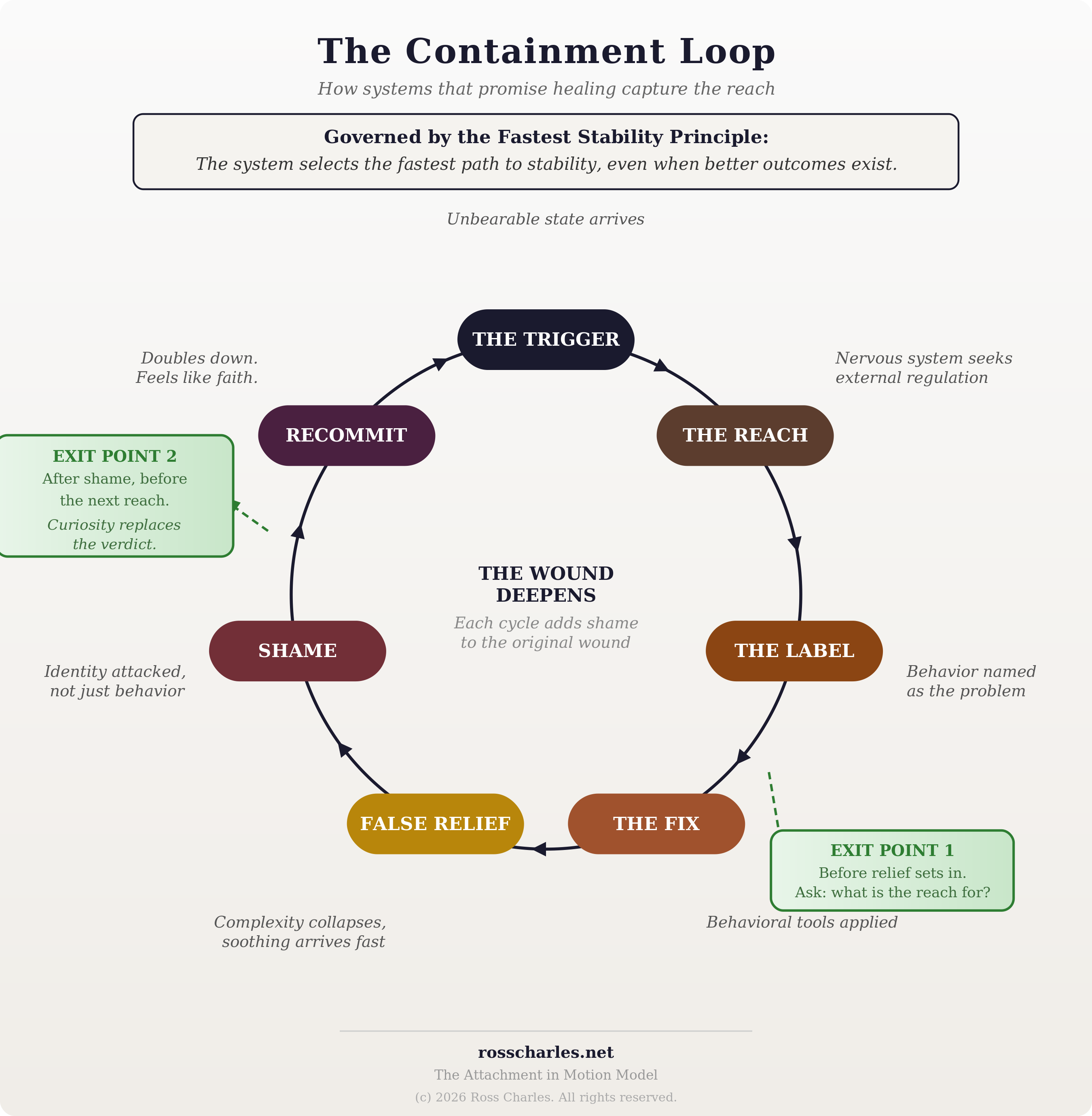
The Containment Loop: the seven-stage cycle that captures the reach for help and redirects it back into the system before it arrives at what it was actually reaching for.
The Five Layers Beneath the Label
If codependency is a regulatory strategy and not a personality defect, then treating it requires seeing the full architecture. The Attachment in Motion Model identifies five layers that organize this pattern from the body up.
Layer 0: Self-Attachment. This is the foundation. Self-attachment is the capacity to remain present in your own body when activation arrives, to feel distress without abandoning yourself to manage someone else's. For the person carrying codependent patterns, this layer was never reliably built. Their earliest experience of distress was met with absence, volatility, or the implicit instruction that someone else's emotional state was more important than theirs. The body learned that its own interior was not a safe place to stay. So it left. It oriented outward. It became an expert at reading other bodies while losing contact with its own.
Layer 1: Borrowed Safety. When self-attachment is absent, the nervous system borrows regulation from external sources. For the codependent pattern, the borrowed safety comes from a specific transaction: I will manage your emotional state, and in exchange, you will provide me with a stable environment. This is not a conscious agreement. It is a nervous system running calculations below the level of awareness. The person does not think I am outsourcing my safety. They think I am helping. I am being a good partner, a good friend, a good child. The behavior looks generous. The architecture is transactional.
Layer 2: Identity Patterns. Over time, the regulatory strategy becomes identity. The person does not just do codependent things. They become the Fixer, the Pleaser, the Chameleon, the one who holds the room together. The pattern hardens from behavior into self-concept. Questioning the pattern no longer feels like examining a strategy. It feels like attacking who they are. This is why insight alone rarely changes codependent behavior. Understanding the pattern intellectually does not dismantle the identity that formed around it.
Layer 3: State-Driven Attachment. This layer explains why codependent patterns are so resistant to change even when the person knows the relationship is harmful. The nervous system does not attach to the person. It attaches to the state the person provides. The calm that comes from being needed. The relief that comes from stabilizing a crisis. The brief reprieve from inner emptiness that arrives when someone else's gratitude fills the space where self-worth should be. When the state is threatened, the nervous system responds as if survival itself is at stake. Because in the original environment, it was.
Layer 4: Relational Imprinting. The deepest layer carries the original template. The relational patterns that were imprinted before language. The body learned what relationships are supposed to feel like, not from theory, but from the specific texture of the first attachments. If love always came with conditions, the body expects conditions. If safety required self-erasure, the body will keep erasing. If connection was available only when the other person's needs were being managed, the body will keep managing. These imprints are not beliefs. They are architecture. And they will reproduce themselves in every significant relationship until the architecture itself is revised.
What Codependency Is Actually Trying to Solve
Here is the part most codependency frameworks leave out entirely.
The codependent pattern is not trying to destroy the person carrying it. It is trying to solve the oldest problem the nervous system has ever encountered: how do I stay safe when the source of safety is also the source of threat?
Every behavior that gets labeled codependent makes perfect sense when viewed through this lens. The scanning of other people's emotional states is hypervigilance repurposed for relational survival. The suppression of personal needs is a calculated reduction of anything that might threaten the attachment. The compulsive helping is a nervous system earning its right to exist in the room. The inability to leave a harmful relationship is not masochism or stupidity. It is a body that cannot distinguish between losing this person and losing access to regulation itself.
The reach is always for safety. The strategy for acquiring safety is what varies. And the strategy called codependency is a body that learned to locate its safety inside someone else's stability because it never learned to produce safety on its own.
That sentence is not a verdict. It is a map. And maps, unlike labels, show you where you actually are and what the terrain looks like between here and somewhere different.
Why the Pattern Reproduces Across Relationships
One of the most painful features of codependency is its apparent inevitability. A person leaves one relationship where they over-functioned and immediately enters another with the same dynamic. They recognize the pattern. They swore they would not repeat it. And they watch themselves repeat it with a clarity that makes the repetition feel like fate.
It is not fate. It is architecture.
When the regulatory strategy is embedded at Layer 1 and fused with identity at Layer 2, the person does not choose the dynamic. Their nervous system selects it before conscious choice engages. The body scans for a specific configuration: someone whose emotional state can be managed, whose instability creates an opening for the codependent person to become essential, whose need matches the shape of the strategy the body already knows how to run.
This is not attraction. It is pattern recognition. The nervous system finds what feels familiar because familiar is what it knows how to survive. The partner who requires management feels like home. Not because it is healthy. Because it activates the circuitry the body has been rehearsing since childhood.
The cruel precision of this mechanism is that it guarantees the person will keep arriving at the same destination regardless of which road they take. Change the partner. Change the city. Change the career. The navigation system remains the same. The body will find a system that needs stabilizing because that is the only environment where it knows how to produce the feeling of safety.
Breaking this pattern does not happen by choosing better. It happens by building the capacity to tolerate the discomfort of choosing differently. And that capacity cannot be built by thinking about it. It has to be built in the body, through lived experience that contradicts the old prediction while the old alarm is still active.
Where the Exit Points Are
If codependency is a structural pattern governed by survival architecture, and if behavioral interventions alone cannot reach the layers where the pattern lives, the question becomes: where does the loop actually become interruptible?
The Attachment in Motion Model identifies two primary exit points.
Before the Reach Completes
The first exit point appears after the trigger and before the borrowed regulation fully engages. There is a moment, sometimes a fraction of a second, when the body activates and the old strategy has not yet locked in. In that window, a question can enter the system: what am I actually reaching for right now? Not what am I doing, which is a behavioral question that the nervous system can easily override. But what state am I trying to produce, which is a question that points at the architecture itself.
Am I reaching for connection or for the feeling of being needed? Am I helping because this person asked for help, or because my body cannot tolerate the sensation of not helping? Am I saying yes because I want to, or because saying no activates a terror that has nothing to do with this particular moment?
These questions do not stop the activation. They create space inside it. And space is where agency lives.
After Shame, Before Recommitment
The second exit point appears after the pattern has run and shame has arrived. There is a moment between the shame verdict and the recommitment to the strategy where a different response becomes possible. Instead of doubling down, instead of trying harder, instead of concluding that the failure proves the defect, the person can meet the shame with curiosity instead of compliance.
This is the question that changes the architecture: what if the shame is not telling me the truth about who I am? What if it is telling me the truth about what I learned to survive? That question does not eliminate the shame. It disrupts its authority. And disrupted authority is the beginning of structural change.
What Would Have to Change
Codependency, understood as a regulatory strategy, does not resolve through better boundaries or more self-awareness alone. Those are useful tools, but they operate at layers that sit above the architecture driving the pattern.
What has to change is the body's relationship to its own interior. The person has to learn, through repetition and lived experience, that their own nervous system can produce safety without borrowing it from an external source. That they can feel distress without leaving themselves to manage someone else. That they can tolerate the discomfort of someone else's displeasure without concluding that the attachment is about to be revoked.
This does not happen through insight. Insight exposes the system. It does not update it. The brain does not update through understanding. It updates through experience that contradicts the old prediction while the old alarm is still active. Every time the body predicts catastrophe and the person remains intact, the forecast weakens. Not overnight. Not in a single dramatic breakthrough. Through slow, unsexy, repetitive neural events that look, from the outside, like ordinary moments of staying.
Staying in the room when the urge to fix is screaming. Staying with the feeling when the impulse to call and check in is running at full volume. Staying in your own body when someone else's distress is trying to recruit you into their regulatory system.
Each time you stay, the body registers a mismatch between what it predicted and what actually happened. That mismatch is the raw material of structural change. Not the affirmation. Not the boundary. The lived experience of surviving what the old architecture said would kill you.
Where to Go from Here
The codependency label was never meant to be a life sentence. It was an observation about a pattern. The Attachment in Motion Model takes that observation and locates it within a five-layer architecture that explains not just what the pattern is, but why the nervous system chose it, where in the body it lives, and how it can be structurally revised.
If the word codependency has been useful, keep it. If it has become another way to indict yourself for a survival strategy that once kept you alive, consider replacing the verdict with the architecture.
The pattern is not evidence that something is wrong with you. It is evidence that your body paid attention to what kept you safe when safety was not reliably available. It is proof that your nervous system calculated, adapted, and refused to let you disappear.
That adaptation was brilliant. It is also exhausting. And the work ahead is not to shame it into silence but to build something underneath it that can hold you without requiring you to hold everyone else first.
The reach was never the problem. What the reach was reaching for is what matters. And what it was reaching for, underneath every compulsive act of helping and fixing and erasing and staying, was the same thing it has always been reaching for.
A body that finally believes it is safe enough to come home to itself.
For the personal, narrative companion to this piece, read The Reach on Substack.