The Boundary That Lasted Forty-Five Minutes
There is a particular kind of defeat that belongs exclusively to the person who set a boundary and meant it.
Not the person who set it carelessly. Not the person who tried it on like a hat they were not sure about. The person who read the book. Highlighted the pages. Practiced the words in the car. Rehearsed the tone. Knew exactly what they were going to say and why they were going to say it. Felt, for a brief and beautiful window, like someone who had finally taken control of something that had been controlling them for years.
And then the phone rang.
Or the text arrived. Or the look on the other person's face shifted half a degree. Or the silence lasted one beat longer than the nervous system was prepared to tolerate. And the boundary, the one that was going to change everything, dissolved like it had never been spoken. Not dramatically. Not in a fight. Just quietly. A sentence swallowed. An accommodation made. A need deferred. The old pattern sliding back into place with the precision of something that has been rehearsing this exact maneuver for decades.
Forty-five minutes. Sometimes less. Sometimes the boundary does not survive the conversation it was set in.
The person does not understand what happened. They had the language. They had the awareness. They knew what healthy looked like and could describe it with clinical accuracy. They could set boundaries for other people all day long. They could spot a codependent pattern from across a parking lot. They could explain attachment theory over dinner and sound like they wrote the textbook.
None of that mattered when the activation hit.
This is the experience that sends people back to therapy convinced something is fundamentally broken in them. That produces the 2 AM Google searches: why can't I keep boundaries, what is wrong with me, why do I keep doing this. That generates the quiet, corrosive shame of watching yourself do the thing you swore you would never do again while the part of you that swore it watches from the back of the room, powerless and bewildered.
The problem is not the boundary. The problem is not the person. The problem is that boundaries are behavioral instructions, and the thing overriding them is not behavioral. It is architectural. It lives in the body at a depth that language cannot reach and willpower cannot override. And until that architecture is visible, the boundary will keep collapsing, and the person will keep concluding that they are the reason it failed.
They are not the reason.
The architecture is.
What a Boundary Actually Is (and What It Is Not)
A boundary, in its simplest form, is a conscious decision about what a person will and will not accept. It is a line drawn by the thinking mind. It exists at the level of intention, language, and deliberate choice.
This is exactly the level at which it has no authority.
That is not a criticism of boundaries. Boundaries are essential. They are the visible architecture of self-respect. They communicate to others what is acceptable and what is not. They create structure in relationships that would otherwise be governed entirely by whoever has the most activation in the room.
But a boundary is a policy. And the nervous system does not follow policy. It follows physics.
The nervous system operates on prediction, not intention. It does not ask what did the person decide. It asks what happened last time. It does not consult the book the person read or the therapist the person spoke with. It consults its own database, a database that has been collecting entries since before the person could walk, a database that is weighted heavily toward experiences that carried survival implications.
When the conscious mind sets a boundary and the nervous system disagrees with the safety implications of that boundary, the nervous system will override the conscious mind. Every time. Not because it is malfunctioning. Because it is running a program that outranks conscious intention in the hierarchy of operations.
Breathing outranks philosophy. Heartbeat outranks belief. Survival architecture outranks the paragraph you highlighted in the self-help book.
This is not a defect. It is the operating system working exactly as designed. The problem is that the design was finalized under conditions that no longer exist, by an architect who was three years old and working with the only data available.
The Half-Second Coup
Here is what actually happens when a boundary collapses. The sequence takes less than a second. The conscious mind, which believes it is in charge, does not find out until it is already over.
A stimulus arrives. A request. A tone shift. A facial expression. A silence. Something in the environment changes in a way that the nervous system's predictive engine has catalogued as relevant. The signal is routed through the amygdala and processed against the body's stored threat database before it reaches the prefrontal cortex, where conscious reasoning lives.
The body's conclusion arrives first. Danger. Not physical danger. Relational danger. The specific kind of danger that was, in the original environment, indistinguishable from physical danger because the child's physical survival depended on the stability of the relational system.
The body responds. Chest tightens. Stomach drops. Heat rises along the neck. Adrenaline enters the system. The vagus nerve adjusts. The entire physiological landscape shifts in service of a single objective: preserve the attachment.
The conscious mind, which set the boundary, which rehearsed the words, which felt confident and clear approximately forty-five minutes ago, now receives a report from a body that is already in survival mode. The report does not say: the other person seems slightly annoyed, you should evaluate your options. The report says: the attachment is at risk, compliance is the fastest path to safety, override the boundary now.
The override is not a decision. It is a reflex. The same category of event as pulling your hand off a hot stove. By the time the conscious mind has assembled an argument for holding the boundary, the body has already folded. The words have been swallowed. The accommodation has been made. The apology has been issued. The boundary is gone.
Afterward, the conscious mind, which missed the coup entirely, tries to reconstruct what happened. And because it was not present for the actual mechanism, it reaches the only conclusion available to it: I failed. I was not strong enough. Something is wrong with me.
Nothing is wrong. The conscious mind was outranked. That is not failure. That is hierarchy.
The Original Contract
The nervous system does not override boundaries arbitrarily. It overrides them in service of a contract that was written before the person had any say in the terms.
The contract is simple. It was negotiated between a child's body and the environment that body depended on for survival. The terms vary by person, but the structure is consistent:
If I reduce what I need, the room stays stable. If the room stays stable, the attachment holds. If the attachment holds, I survive.
Or: if I become useful, I become necessary. If I become necessary, I become harder to discard. If I am harder to discard, I am safer.
Or: if I absorb this person's emotional surplus, the crisis de-escalates. If the crisis de-escalates, no one gets hurt. If no one gets hurt, I can stay.
These are not beliefs. They are equations. They were solved by a body that could not yet speak in complete sentences, using data that was collected under conditions of genuine threat. The solutions worked. The child survived. And the equations were preserved in the architecture the way load-bearing walls are preserved in a building: not because anyone chose to keep them, but because removing them feels like the whole structure might come down.
A boundary, from the perspective of the conscious mind, is a healthy act of self-definition.
A boundary, from the perspective of the survival architecture, is a unilateral renegotiation of a contract that kept the organism alive.
The architecture does not care that the contract is outdated. It does not care that the person is forty-three years old and financially independent and living in a different state. It cares that the equation was solved, and the solution worked, and changing the solution introduces a variable the system cannot predict.
Unpredictability was the original threat. The architecture will not voluntarily introduce more of it. Not for a boundary. Not for a book. Not for a therapist who says this will be good for you.
The architecture will hold the old contract until something more convincing than language tells it the contract can be safely revised.
Why the Usual Advice Fails
The standard boundary-setting curriculum looks approximately like this: identify what you need, communicate it clearly, hold the line, tolerate the discomfort.
Steps one through three operate at the level of conscious thought. Step four is where the curriculum falls apart, because the discomfort it is asking the person to tolerate is not discomfort in the conversational sense. It is activation in the survival sense. The body is not experiencing mild social awkwardness. It is experiencing a threat to the attachment bond that its entire regulatory architecture is organized around.
Telling someone to tolerate that is like telling someone to tolerate a fire alarm by sitting calmly in the building. The alarm is not a suggestion. It is an emergency broadcast. And the body treats it as one.
"Just Hold the Line"
This instruction assumes the person has a stable internal foundation to hold from. For someone whose regulatory architecture was built on borrowed safety, there is no stable internal foundation. The foundation is the relationship. The foundation is the other person's approval. The foundation is the absence of conflict. Holding the line means standing on nothing. The instruction is not difficult. It is, given the architecture, structurally impossible until something changes beneath it.
"The Discomfort Will Pass"
Sometimes it does. For someone with a secure attachment foundation, the discomfort of setting a boundary is temporary and manageable. For someone whose nervous system interprets boundary-setting as a threat to survival, the discomfort does not pass. It escalates. The body recruits more and more of the stress response system. The chest gets tighter. The thoughts get louder. The certainty that something terrible is about to happen intensifies until the person either folds the boundary or dissociates to survive the experience of holding it. Neither outcome constitutes healthy boundary-setting.
"Practice Makes It Easier"
This one contains a grain of truth wrapped in a critical omission. Repetition does change neural pathways. But the repetition that changes them is not the repetition of setting boundaries. It is the repetition of surviving the activation that follows. If the person sets a boundary, floods with terror, collapses the boundary, and then gets shamed for the collapse, the neural pathway that gets reinforced is the one that says boundaries are dangerous. Practice, in this case, makes the pattern worse.
The missing piece in all of this advice is the same missing piece that runs through most behavioral interventions for structurally governed patterns: the advice addresses the behavior without addressing the body. And the body is where the override lives.
The Four Layers That Override the Boundary
The Attachment in Motion Model identifies four layers of architecture that participate in the override. Each one operates at a different depth, and each one can collapse a boundary independently. In most cases, they work together.
Layer 1: Borrowed Safety. The person's internal stability is not self-generated. It is borrowed from the external system they are trying to set a boundary with. This means the act of setting the boundary destabilizes the very foundation the person needs in order to hold it. It is a structural paradox. The person is attempting to create distance from the source of their regulation while depending on that source to remain regulated enough to maintain the distance. The boundary threatens the supply line it needs to survive.
Layer 2: Identity Patterns. The boundary conflicts with the person's identity structure. If the person is the Pleaser, the boundary contradicts who they are. If they are the Fixer, leaving a problem unresolved feels like abandoning their post. If they are the Performer, the other person's displeasure registers as a failed performance review. The identity pattern does not experience the boundary as self-care. It experiences it as identity betrayal. And the body will defend identity with the same intensity it defends physical safety, because in the original environment, identity and safety were the same thing.
Layer 3: State-Driven Attachment. The person is not attached to the other person in the way they think they are. They are attached to the state the relationship provides. The calm of being needed. The relief of a resolved conflict. The settling that happens when the other person's face relaxes. When the boundary disrupts that state, the nervous system does not register a social inconvenience. It registers the loss of its primary regulatory input. The craving that follows is not emotional weakness. It is a body experiencing withdrawal from its most familiar source of borrowed regulation.
Layer 4: Relational Imprinting. At the deepest layer, the boundary activates the original relational template. The body does not respond to the current relationship. It responds to the pattern the current relationship was selected to match. If the original template says love requires self-erasure, the boundary feels like a betrayal of love itself. If the original template says connection requires compliance, the boundary registers as a voluntary disconnection from the only kind of connection the body knows how to run.
When all four layers activate simultaneously, the conscious mind's decision to set a boundary has approximately the same authority as a sticky note on the dashboard of a car that is already in motion. The note says turn left. The car is going straight. The car was always going to go straight. The note was never driving.
The Containment Loop and the Boundary Cycle
Boundaries that collapse do not simply fail and disappear. They enter a specific cycle that reinforces the pattern and makes the next attempt harder. The Attachment in Motion Model maps this cycle as the Containment Loop.
The sequence runs like this:
Trigger: Something activates the need for a boundary. A request that crosses a line. A dynamic that has become intolerable. A moment of clarity where the person sees the pattern and decides to interrupt it.
Reach: The person reaches for the boundary. They speak it. They hold it. For a moment, there is a feeling of agency and alignment. This is the reach toward self-attachment, toward internal regulation. It is genuine.
Label: The activation arrives. The nervous system labels the boundary as a threat. Not intellectually. Physiologically. The body begins running the old equations. The survival architecture comes online.
Fix: The person attempts to manage the activation by managing the other person's response. They soften the boundary. They explain it. They apologize for it. They negotiate it downward until it no longer functions as a boundary. The fix is not resolution. It is the borrowed safety mechanism reasserting itself.
False Relief: The other person's displeasure eases. The room stabilizes. The activation settles. The person feels temporary relief and mistakes it for evidence that the compromise was the right call.
Shame: Hours later, sometimes days, the recognition arrives. The boundary is gone. The pattern reasserted. The person did the thing again. Shame steps in with its standard verdict: you are weak, you cannot change, this is who you are.
Recommitment: The person resolves to try harder next time. They buy another book. They schedule another session. They rehearse the words again. The recommitment feels like progress. It is the loop resetting.
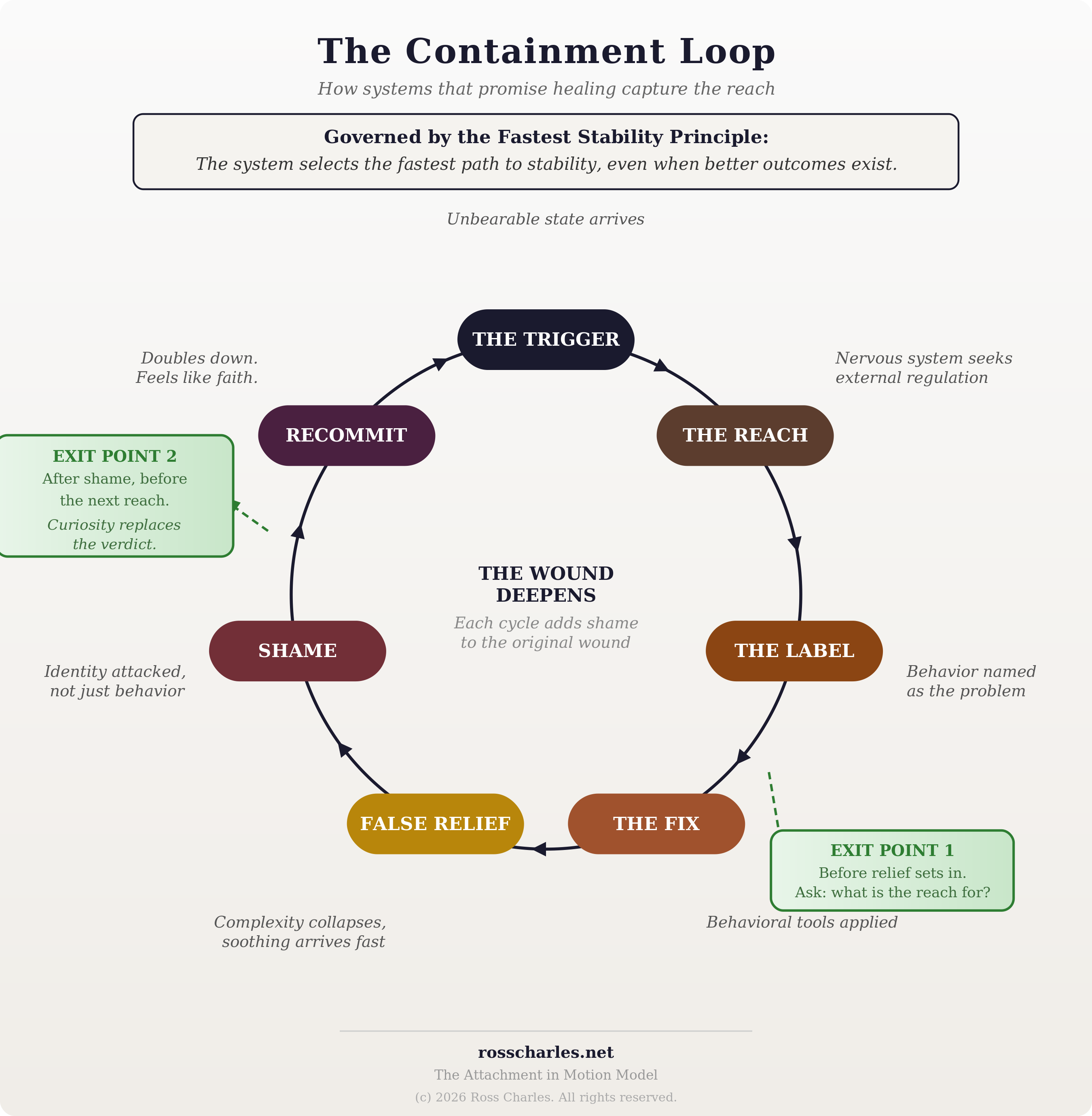
The Containment Loop applied to the boundary cycle. Each failed boundary does not interrupt the pattern. It completes another revolution.
The cruelty of this cycle is that the recommitment phase feels like the beginning of change. It is not. It is the last stage of the loop. The person has just completed a full revolution and is now positioned to run it again with more shame and less confidence.
Every failed boundary that ends in self-blame makes the next boundary attempt more expensive. The activation will be higher. The shame will arrive faster. The window between setting the boundary and folding it will be shorter. The pattern is not static. It is compounding.
Where Boundaries Actually Become Possible
If the boundary is collapsing because the architecture underneath it cannot support it, then the work is not to set better boundaries. The work is to change what the body believes about the cost of holding one.
That sentence sounds simple. It is the hardest work most people will ever do. Because the body's beliefs about boundaries were not formed through reasoning, and they will not be revised through reasoning. They were formed through lived experience, and they will only be revised the same way.
The Micro-Hold
Structural change does not begin with the boundary that will redefine the relationship. It begins with the smallest possible boundary the nervous system can tolerate without flooding. Not the hard conversation. Not the ultimatum. The text that is not returned immediately. The favor that is declined without explanation. The five minutes of silence that are allowed to exist without being filled. The micro-hold is not impressive. It is not the stuff of Instagram recovery posts. It is the body's first experience of surviving a boundary without the predicted catastrophe arriving.
That survival is a neural event. It contradicts the old forecast. And contradicted forecasts, accumulated over time, are the raw material of architectural change.
Staying in the Activation Without Folding or Dissociating
The window between setting a boundary and folding it is the window where the work actually happens. Not the setting. Not the holding. The surviving of the activation that follows. If a person can stay present in their own body while the chest tightens and the stomach drops and the ancient prediction that everything is about to fall apart runs at full volume, and if the catastrophe does not arrive, the body registers a mismatch. The prediction said annihilation. The outcome was discomfort. That mismatch, experienced while the old alarm is active, is what updates the architecture.
This is why white-knuckling a boundary through dissociation does not produce structural change. The person held the line, but they left their body to do it. The nervous system was not present for the contradiction. No mismatch was registered. No update occurred. The next time the boundary is needed, the old forecast runs at the same intensity as before.
Building Layer 0
The deepest intervention is the one the Attachment in Motion Model places at the foundation: Self-Attachment. The capacity to remain in contact with your own interior when the room around you shifts. To feel the activation and not abandon yourself to manage someone else's response. To know, in the body, that your own experience is a valid place to stand.
Self-attachment is what makes the boundary possible. Not because it eliminates the activation. Because it provides somewhere to stand while the activation runs. Without it, the person sets the boundary from borrowed ground. With it, the boundary has a foundation that does not depend on the other person's response.
This is not built through affirmation. It is built the same way the original architecture was built: through repetition. Through thousands of small moments where the person stays in contact with themselves when the old program says leave. Where they notice the scan starting and do not follow it. Where they feel the pull toward accommodation and pause instead of comply. Where the body learns, one neural event at a time, that it can tolerate the gap between the old prediction and the new reality.
The Boundary Is Not the Goal
This is the part that most boundary-setting frameworks never arrive at, because they treat the boundary as the destination. It is not. It is the symptom of something deeper having changed.
A person who has built self-attachment does not experience boundary-setting as an act of warfare. They do not have to rehearse words in the car. They do not have to brace for impact. The boundary arises naturally from a body that knows where it ends and where the other person begins. It does not require courage because it does not register as dangerous. It is simply information. This is where I am. This is what I need. This is what I can and cannot offer.
That ease is not a personality trait. It is an architectural outcome. It is what happens when the body no longer believes that honesty will cost it everything. When the survival contract has been renegotiated at the level it was originally written: not in language, but in tissue.
The person who cannot hold a boundary is not weak. They are attempting to execute a surface-level instruction while a survival-level architecture runs a contradictory program at a deeper layer of the system. That is not a character problem. It is an engineering problem. And engineering problems do not respond to motivational speeches. They respond to structural intervention.
The boundary will hold when the body that sets it no longer believes the boundary will kill it.
That belief does not change through understanding.
It changes through experience.
One micro-hold at a time.
For the structural framework behind codependent boundary patterns, see Codependency Is Not a Personality Flaw. It Is a Regulatory Strategy.
For the identity patterns that override boundaries before conscious choice arrives, see People-Pleasing Is Not Kindness. It Is a Surveillance System.
For the personal, narrative companion to this work, read The Reach on Substack.