There is a specific experience that persists across recovery programs, self-help frameworks, therapeutic interventions, and faith-based healing systems. A person identifies a problem. They enter a program designed to address it. They do the work. They experience genuine progress. Then activation arrives, and the old pattern reasserts. They conclude they did not try hard enough, re-enter the program or try a new one, and the cycle repeats.
This is not a failure of willpower, discipline, or commitment. It is not evidence that the person is broken or that the problem is too deep to reach. It is a structural pattern with a specific mechanism, and that mechanism can be named.
The Attachment in Motion Model identifies this pattern as the Containment Loop: a self-reinforcing cycle in which systems that promise healing capture the reach for help and redirect it back into the system before it can arrive at what it was actually reaching for.
The loop does not require malice. It does not require incompetence. It runs through well-intentioned systems staffed by genuinely caring people. It runs because the system is structured to intervene at the behavioral level while the problem operates at the regulatory level. The mismatch between the level of intervention and the level of the problem is what makes the cycle repeat.
How the Containment Loop Operates
The loop runs in a precise sequence. Each stage produces the next, and the final stage feeds back into the first. Once established, the loop does not require external maintenance. Shame makes it self-sustaining.
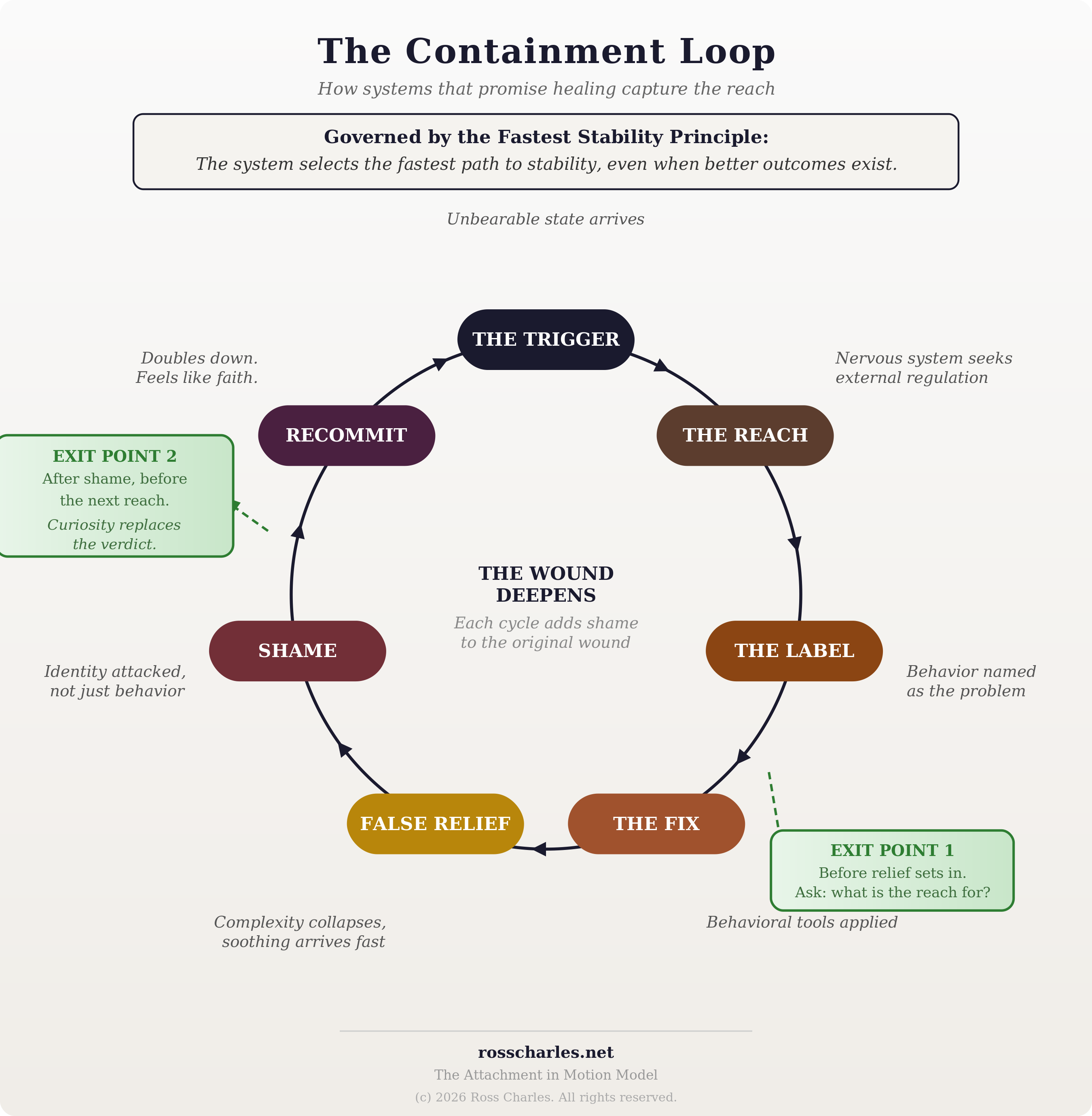
The Trigger and the Reach
An unbearable internal state arrives. It may be dramatic or quiet: loneliness, restlessness, the unnamed emptiness that appears in the spaces between motion, or shame from the last cycle. The nervous system reads the state as a signal and asks the question it has been asking since the wound formed: is this safe to stay with?
The answer, in a system with insufficient self-attachment capacity, is no. So the system does what it learned to do. It reaches. Not from weakness. From intelligence. The reach is an attachment behavior. It is the nervous system attempting to regulate an unbearable state by finding something outside itself that can do what the inside cannot. Every reach, whether it takes the form of a relationship, a substance, a role, a belief system, or a recovery program, is trying to solve an attachment wound. This is the foundational claim of the model: it is always the reach, and it is always attachment.
The Label
A system observes the reach. Religion names it sin or spiritual immaturity. Warrior culture names it weakness or softness. Coaching culture names it a limiting belief or a mindset problem. Clinical frameworks may name it a disorder, a maladaptive pattern, or a defense mechanism. Recovery programs name it codependency, addiction, or anxious attachment.
The label is always a judgment on the behavior. It accurately describes the behavioral output. But it does not ask what the reach is trying to get to. It does not develop curiosity about the function. It identifies the reach as the problem and prepares to address the problem directly. This is the moment the capture begins.
The Fix
The system offers a solution matched to the label. Behavior modification. Accountability structures. Spiritual discipline. Boundary-setting protocols. Steps, homework, frameworks, or doctrine. The fix is always aimed at the behavior: stop the reach, replace it with the correct behavior, build the right habit, submit to the right authority.
The fix makes sense on the surface because it addresses what is visible. What it does not address is the regulatory wound the behavior was attempting to solve. The system intervenes at the output layer while the problem operates at the foundation.
False Relief
This is the most important stage in the loop, because the fix works. At least briefly. Complexity collapses. Someone has the answer. There is a plan. The unbearable feeling has somewhere to go. The nervous system, which was dysregulated and searching, experiences something that feels like regulation.
The relief is real enough to feel like progress. Real enough to recommend the system to others. Real enough to stay. This is the seduction. The collapse of complexity is not a side effect. It is the mechanism of capture. When a dysregulated nervous system encounters certainty, structure, and a clear path forward, it soothes. The soothing is genuine. And it is what makes the loop invisible.
Shame Seeds and Enforces
Underneath the relief, something quieter is happening. The label stuck. The reach was named as wrong. Which means the person who reached was wrong. Shame does not attack behavior. It attacks identity. The person does not think they did something wrong. They think they are something wrong.
Shame is not a regulator. It is an accelerant. It takes the body's legitimate signal that something is not working and reframes it as evidence of personal defect. The verdict does not need to be accurate. It needs to be fast. It needs to return the person to the identity before the questioning can finish.
The behavior gets labeled. Shame arrives. Shame is itself an unbearable internal state. So the person reaches again for the thing that works, the only thing that has ever worked, and now they have proven the system's diagnosis. The label gets reinforced. More shame. The loop tightens.
Recommitment
The person recommits. They double down on the system, the practice, the doctrine, the framework. They try harder. They believe more deeply. They submit more completely. And here is what makes this the cruelest stage: recommitment feels noble. It looks like faithfulness. It looks like growth. It looks like strength. The system rewards it. The community affirms it.
And the wound deepens quietly underneath, unaddressed, now carrying the additional weight of shame about the reaching that was never allowed to be curious about itself.
Recommitment becomes the new baseline. The wound that triggered the original reach is still present, now compounded by the shame the system added. The next trigger arrives, often sooner and stronger than the last, because the system is now regulating two wounds instead of one. The reach happens again. The loop closes.
Why This Is a Structural Problem, Not a Personal One
The Containment Loop is governed by the Fastest Stability Principle, the foundational axiom of the Attachment in Motion Model: any system under pressure will select the fastest available path to stability with the lowest perceived cost, and reuse it, even when better outcomes exist.
This principle explains every stage of the loop. The reach is the fastest available path to regulation. The system's label and fix provide the fastest available path to relief. Shame provides the fastest available path to a verdict about the self. Recommitment provides the fastest available path to restored standing within the community.
At every stage, the system is doing exactly what the principle predicts. It is selecting the fastest resolution. The problem is that the fastest resolution at each stage is not the same thing as the correct resolution. Speed and depth are inversely related in this architecture. The faster the relief, the less likely it is addressing the regulatory layer where the problem actually lives.
This is why the pattern repeats despite genuine effort. The person is not failing. The intervention is operating at the wrong level. Behavioral tools collapse under activation because they were installed at the cognitive or behavioral layer, while the system under pressure reverts to regulatory pathways that were wired before the tools existed. This is not a matter of practice or commitment. It is a structural mismatch.
Where the Containment Loop Runs
The loop runs through any system that meets the reach with a label before it meets it with curiosity. The specific content of the label varies. The structure is identical.
Religious and Faith-Based Systems
Religious systems are among the most effective containers of the loop because they provide the full package: community, identity, moral architecture, and the certainty that collapses complexity. The reach is named as sin or spiritual immaturity. The fix is repentance, discipline, and restored standing within the community. The relief of belonging is genuine.
The additional weight that religious systems carry is the framing of the internal voice as untrustworthy. Systems that train people to distrust their own intuition, emotion, and judgment as sources of sin or spiritual deception close the only exit from the loop before the person ever arrives at it. The exit requires access to internal experience. Systems that delegitimize that access have sealed the loop structurally.
Warrior Culture and Masculinity Frameworks
Warrior culture runs the loop through the language of strength and weakness. The reach is labeled as softness, emotionality, or neediness. The fix is harder discipline, greater endurance, deeper suppression of the internal signal. The relief comes from the affirmation of identity as strong, capable, and unbreakable.
The attachment wound, which is fundamentally a wound of unmet need, is the exact thing the system is structured to eliminate through the performance of its opposite. The predictable outputs are addiction, rage, disconnection, and collapse dressed as strength.
Coaching and Self-Development Culture
Coaching culture runs a more sophisticated version of the loop. It uses the language of growth, potential, and transformation. The reach is identified as a limiting belief, a mindset problem, or a gap between current and desired state. The fix is a framework, a goal, a practice, an accountability structure. The relief comes from the sense of forward motion and the coach's certainty.
The specific seduction of coaching culture is that it presents the fix as empowering. The person is not being corrected. They are being developed. But the effect on the loop is identical: the reach has been labeled and addressed at the behavioral level without any curiosity about what the reach was trying to get to.
Clinical and Therapeutic Frameworks
This must be named with care, because therapy has the most potential to interrupt the loop and also a version that can run it.
Therapy anchored in curiosity about function, that treats the reach as information rather than pathology, that builds the capacity for self-attachment as the foundation of everything else, works directly against the loop. Good therapy is one of the few environments where the exit can be reliably accessed.
But therapy that deploys diagnosis as a label, that orients toward behavior modification as the primary intervention, that provides homework before safety, or that meets the reach with interpretation rather than curiosity, can run a clinical version of the loop. The diagnostic language becomes the label. The treatment protocol becomes the fix. The brief reduction in distress becomes the false relief. And the shame of still struggling despite treatment becomes the enforcer.
The Two Points Where the Loop Can Be Interrupted
The loop is not inescapable. At two points in the sequence, awareness can arrive and a different choice can enter. These are not easy moments. They are narrow and they are costly. But they exist.
Both exits require the same thing: curiosity meeting the reach instead of judgment correcting it.
Before the Relief Sets In
The first exit occurs between the label and the false relief. The label has just landed. The fix has been offered. Complexity is beginning to collapse. And there is a moment, small and easily missed, where a question is possible: Is this label actually true about me? What is the reach really for? What am I trying to get to?
Most people do not take this exit because the relief arrives too fast. The nervous system, which is dysregulated and searching, accepts the first thing that soothes. The label and the fix arrive together as a package and the package comes with relief attached. By the time the question could form, the relief has already closed the window.
This is why curiosity has to be cultivated before the trigger arrives. A person who has never practiced staying with a feeling cannot suddenly do so when a label, a fix, and relief are all being offered simultaneously. The exit exists. The capacity to use it has to be built.
After Shame, Before the Next Reach
The second exit occurs later in the loop, after shame has become its own trigger, and before the next reach begins. This is the moment that often presents as the question: why do I keep doing this?
Most people answer this question inside the system's framework. Because I am weak. Because I am not disciplined enough. Because I have not submitted fully enough. The system has already provided the answer, and shame has made the answer feel true.
But the question itself, the naked moment of why do I keep returning, is an exit. If it can be met with curiosity rather than the system's verdict, something different becomes possible. The questions that matter at this point are not the system's questions. They are: What was I reaching for? What state was I trying to get to? What is the earliest version of this reach I can remember? What was not available then that I have been trying to replace ever since?
This exit is harder to use because by this point the shame is loud and the system's answer is already present. Using it requires standing against the framework that has been providing structure, community, and identity. It requires tolerating the disorientation of not having a ready answer. The cost is genuinely high, which is why most people do not take it.
What Would Have to Change
The Containment Loop captures the reach because it intervenes at the behavioral level while the problem operates at the regulatory level. The exit from the loop is therefore not a better behavioral program. It is a shift in the level of intervention.
The question that breaks the loop is not what should I do differently. It is what regulatory conditions make the old behavior the fastest available path to stability, and how do those conditions change.
The Attachment in Motion Model locates the answer in Layer 0: self-attachment capacity. This is the nervous system's ability to remain present with internal experience without initiating an exit strategy. It is composed of five measurable dimensions: how long the system can stay present, how much intensity it can tolerate, whether it stays with the actual signal or substitutes a narrative, whether it holds under relational input, and how quickly it re-establishes contact after losing it.
When self-attachment capacity is insufficient, the system must source regulation externally. This is not a choice. It is a structural compensation. And every external source of regulation, whether it is a person, a role, a substance, a belief system, or a recovery program, carries the risk of running the Containment Loop if it meets the reach with a label before it meets it with curiosity.
Increasing self-attachment capacity does not happen through insight. It happens through repeated experience where the nervous system stays with a signal it previously exited from and discovers that it survived. Not once. Repeatedly. Each time the system remains present with something it believed was dangerous and discovers the danger did not materialize, it files a new data point. Over time, those data points erode the authority of the old prediction. The old pattern does not disappear. It loses dominance. A new pathway becomes available, and eventually faster.
When the internal capacity increases, the structural necessity for externalized regulation decreases. Identity patterns that existed to maintain access to external regulation begin to loosen because they are no longer required. Behavioral change emerges as a downstream effect rather than a target. The loop loses its hold not because the person resisted it, but because the regulatory conditions that made the loop necessary have changed.
Where to Go From Here
This article describes one mechanism within a larger architecture. The Attachment in Motion Model defines a five-layer system that explains where human regulation, identity, and belonging come from, what happens when the source is external, and what it takes to change the structure rather than the surface.
The full model, including the Self-Attachment Framework, the Borrowed Safety Model, the Identity Pattern Framework, the State-Driven Attachment Model, the Relational Imprint Model, and the Containment Loop, is available at rosscharles.net.
Ongoing writing developing these ideas is published at rosscharles.substack.com.
The reach was never the problem. The reach was the most honest thing. What was reaching, underneath all of it, was trying to get back to something that was missing before the system ever arrived. That something is self-attachment. The capacity to stay with yourself. To be a place you can land.