The Nicest Person in the Room Is Running the Most Expensive Program
People-pleasing is one of the most socially rewarded survival strategies in existence. It gets called kindness. Empathy. Emotional intelligence. Being a good listener. Being the person everyone can count on. Being low-maintenance. Being easy to love.
None of those descriptions are wrong, exactly. They are just incomplete in a way that costs the person carrying them everything.
Because underneath the warmth, underneath the availability, underneath the compulsive willingness to show up for everyone else before the thought of showing up for yourself has even crossed the threshold of consciousness, there is a system running. It has been running since before the person carrying it had language. It does not take days off. It does not negotiate. And it is burning more energy than almost anyone around them will ever see.
The people-pleaser is not generous by default. They are scanning by default. They are reading the room the way air traffic control reads radar: constantly, automatically, with a precision that looks effortless from the outside and feels like a second full-time job from the inside.
What are they scanning for? Not compliments. Not approval in the abstract. They are scanning for the micro-shifts in emotional weather that signal danger. A change in someone's tone. A pause that lasts one beat too long. A text that arrives without its usual warmth. A face that rearranges itself between sentences.
The people-pleaser does not register these signals as social information. Their nervous system registers them as threat data. And the response is immediate, pre-verbal, and non-negotiable: fix it before it becomes a problem. Adjust before you are asked to. Give before the withdrawal happens. Become whatever the room needs so the room does not become what you fear.
That is not empathy. That is hypervigilance wearing empathy's clothes.
Where the Program Was Written
Every people-pleasing pattern has an origin story, and it is never the one the person tells themselves. The story they tell is usually some version of: I am just wired this way. I care too much. I have always been the one who holds things together.
The story the body tells is different.
Before a child can speak in complete sentences, their nervous system has already completed a comprehensive survey of their relational environment and delivered its findings. The findings are not stored as thoughts. They are stored as rules. And the rules are written in the only language the body speaks at that age: what keeps me connected, and what gets me abandoned.
For the child who becomes a people-pleaser, the survey returned a specific set of data points.
Expressing needs produced tension in the adults. Tension in the adults produced instability. Instability felt like the floor disappearing. The child's nervous system made a calculation that was, given the available information, perfectly rational: reduce the tension. Minimize what you need. Become easy. Become pleasant. Become the variable in the room that never adds to the chaos.
This was not a choice. It was an adaptation. The child did not sit down and develop a philosophy of selflessness. Their body learned, through hundreds of small repetitions, that agreeableness was the cheapest insurance policy against the thing they feared most: disconnection from the people they could not survive without.
The program was installed before the child knew it was being installed. And because it worked, because agreeableness genuinely did reduce tension and preserve connection in the original environment, the nervous system flagged it as essential. Not useful. Essential. Non-negotiable. The way breathing is non-negotiable.
That is the part most people-pleasing frameworks miss entirely. They treat the pattern as a habit that can be broken through awareness and willpower. The nervous system treats it as a survival protocol that runs at the same priority level as keeping the heart beating.
Willpower does not outrank the autonomic nervous system. It never has.
The Actual Architecture of the Pattern
People-pleasing, understood structurally, operates across multiple layers simultaneously. The Attachment in Motion Model maps these layers from the body up.
The Scanner Layer
The first layer is perceptual. The nervous system is running a continuous environmental scan, monitoring the emotional states of the people in the room with a level of resolution that would be impressive if it were not so expensive. Facial micro-expressions. Vocal tone shifts. The rhythm of someone's breathing. The distance between what a person says and what their body is doing. The people-pleaser processes all of this data in real time, below the threshold of conscious awareness, and converts it into a threat assessment that updates constantly.
This is not intuition. This is a surveillance system that was designed by a child who needed to predict emotional weather in order to stay safe. It is Layer 3 of the model: State-Driven Attachment. The person is not attached to the people around them. They are attached to the state of the room. When the room is stable, their system is stable. When the room shifts, their system activates.
The Pleaser: Identity Fused with Strategy
The second layer is where the Scanner's output becomes behavior. Once a potential threat is detected, a shift in someone's mood, an unmet need, the faintest whiff of displeasure, the Pleaser activates. This is the identity pattern the Attachment in Motion Model names at Layer 2. It is the part that looks like generosity. The person adjusts. They give. They volunteer. They absorb. They de-escalate. They become whatever shape the moment requires.
What is actually happening is self-erasure. The person is not adding to the room. They are subtracting from themselves. Every adjustment comes at a cost: a preference unexpressed, a boundary unmaintained, a need deferred, an opinion swallowed. The Pleaser does not keep a running tab. It simply deletes. And after years of deleting, the person looks around and cannot find themselves in their own life. Not because they lost themselves dramatically. Because they subtracted themselves incrementally, one micro-accommodation at a time, until the remainder was too small to feel.
The Pleaser is not a behavior the person does. It is who they have become. The strategy has hardened into a self-concept. Questioning it does not feel like self-examination. It feels like an attack on identity itself. This is what makes identity patterns so resistant to change: the person is not defending a habit. They are defending the only version of themselves that has ever felt safe enough to exist.
Borrowed Safety: The Transaction That Was Never Negotiated
The third layer is where the cost compounds. This is Layer 1 of the model: Borrowed Safety. Every act of people-pleasing is, at the nervous system level, a transaction. The person gives without being asked and then cannot understand why resentment builds. They accommodate without negotiation and then feel invisible when no one reciprocates. They erase their needs so effectively that the people around them genuinely do not know those needs exist, and then interpret the ignorance as evidence that they do not matter.
This is where people-pleasing stops feeling like warmth and starts feeling like a trap. Because the transaction was never explicit. The people-pleaser did not say: I will manage your emotional state, and in return, you will provide me with proof that I am valued. That agreement was written in the body, not in conversation. The person is borrowing their sense of safety from the stability of the room they are managing. When the implicit terms are not met, because the other person never knew they existed, the people-pleaser does not renegotiate. They double down. They give more. They erase more. They scan harder. The Borrowed Safety has to be maintained because the alternative is the original terror.
Inside the Containment Loop, this is where the cycle accelerates. The person reaches for safety through the only strategy available. The strategy produces short-term relief and long-term depletion. Shame arrives to explain the depletion as personal failure. And the loop resets with more urgency.
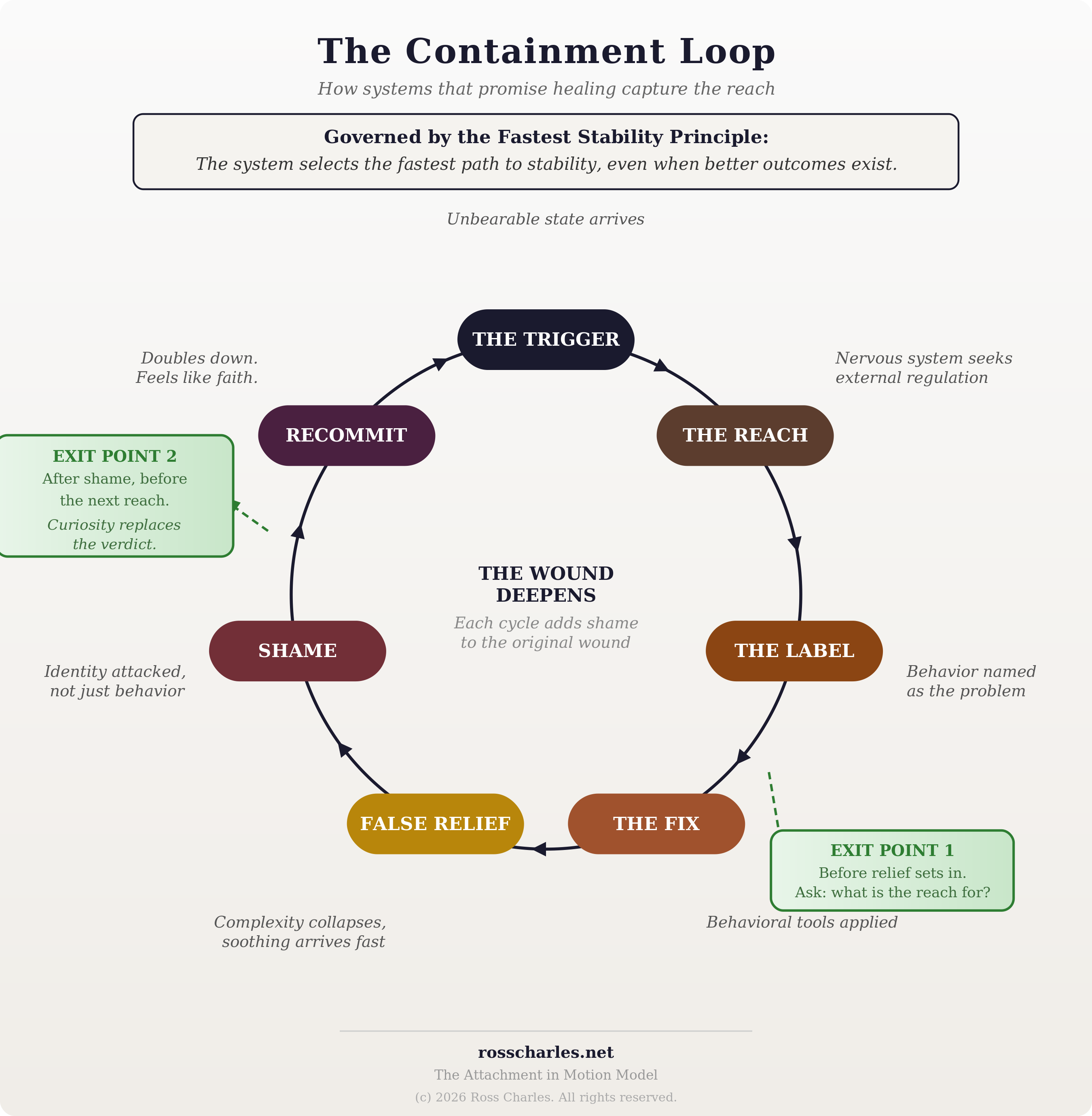
The Containment Loop: the seven-stage cycle that captures the reach for help and redirects it back into the system. The people-pleasing pattern runs this loop at high speed, with shame as its primary enforcement mechanism.
Why "Just Say No" Does Not Work
The most common advice given to people-pleasers is to set boundaries and learn to say no. This advice is technically correct in the same way that telling someone with a broken leg to walk it off is technically a description of locomotion.
The instruction targets the output. The problem lives in the operating system.
When a people-pleaser attempts to say no, the following sequence fires in approximately half a second:
The word no forms in the mind. The nervous system interprets the word as a threat to the attachment. Activation fires: chest tightens, stomach drops, heat rises along the neck. The body predicts the consequence of the boundary based on decades of stored data: tension, withdrawal, disconnection, abandonment. The survival architecture overrides the conscious intention. The person says yes, or says no and immediately begins managing the other person's response to the no, which is just people-pleasing with extra steps.
This is not weakness. This is a nervous system executing a program that has been reinforced thousands of times and carries the authority of a survival protocol. Telling that system to "just say no" is like telling a smoke detector to stop responding to smoke. The system is not malfunctioning. It is doing exactly what it was designed to do.
The design is the problem. And you do not fix a design flaw with a motivational quote.
The Difference Between Genuine Generosity and Survival Generosity
This is the question that makes the architecture visible: can you not help?
Not should you. Not would it be healthier to. Can you physically, neurologically tolerate the sensation of someone else's unresolved distress without intervening?
Genuine generosity is a choice made from surplus. The person has access to their own internal stability. They are not scanning the room for threats. They offer help because they want to, and they can tolerate the discomfort of the other person declining or not reciprocating. The help does not carry a hidden invoice. The giving does not require a return. The person remains intact whether the help lands or not.
Survival generosity is a compulsion driven by deficit. The person is scanning the room continuously. They offer help because their nervous system cannot tolerate the activation that comes from not offering. The help is an attempt to regulate the emotional weather of the room, which is an attempt to regulate their own internal state. If the help is declined, the activation increases. If the help is not reciprocated, resentment builds. The person does not remain intact. They fragment, because the transaction that was supposed to produce safety did not complete.
From the outside, both look identical. From the inside, they run on completely different circuitry. One is connection. The other is dependency wearing connection's name badge.
The distinction matters because it determines what the person is actually working with. If the behavior is genuine generosity that has gotten slightly out of balance, behavioral adjustments will help. If the behavior is survival generosity running on decades of reinforced architecture, behavioral adjustments will collapse under the first significant activation and the person will conclude, once again, that they are the problem.
What the Pattern Costs
The costs of people-pleasing are cumulative and largely invisible, which is part of what makes the pattern so durable. Each individual act of self-erasure is small enough to dismiss. The aggregate is devastating.
Loss of Internal Contact
The most expensive cost is the one that is hardest to measure. Over years of orienting outward, the person loses reliable access to their own interior. They stop knowing what they want because wanting was edited out of the program long ago. They struggle to identify their own emotions because their attentional system has been allocated entirely to monitoring other people's emotions. They cannot answer the question "what do you need" because the surveillance system was never pointed inward.
Relationship Distortion
People-pleasing creates a specific relational paradox. The person over-gives in order to maintain connection, but the over-giving prevents genuine connection from forming. Intimacy requires two whole people in the room. The people-pleaser brings half of one. The parts that might create friction, the real opinions, the inconvenient needs, the honest reactions, were removed before entry. What the other person connects with is the curated version. And the people-pleaser knows this, somewhere below the surface, which is why the connection never quite settles into safety. It cannot. Because they are not fully in it.
Chronic Physiological Cost
Running a surveillance system around the clock is not a metaphor. It is a metabolic reality. Hypervigilance is expensive. Chronic suppression of personal needs generates measurable physiological stress. The immune system pays. Sleep quality pays. The inflammatory response pays. The body is running a program that demands continuous output and provides no recovery window. Over decades, the invoice arrives as exhaustion that rest does not fix, because the exhaustion is not from activity. It is from the unrelenting labor of scanning, adjusting, and accommodating.
Where the Pattern Can Be Interrupted
If people-pleasing is a regulatory strategy operating at the level of survival architecture, the intervention has to meet the pattern where it actually lives. Behavioral tools are useful. They are not sufficient. The interruption points exist at each layer of the architecture.
At the Scanner Layer: Noticing the Scan
The first point of intervention is not stopping the scan. It is noticing it. Most people-pleasers are unaware that they are scanning. The process is so automated that it registers as normal perception rather than threat assessment. The shift begins when the person starts to catch the scan in progress. To notice, in real time, that their attention has left their own body and migrated to someone else's emotional state. That noticing does not stop the pattern. It creates a gap between the signal and the response. And in that gap, something other than the automatic reaction becomes possible.
At the Pleaser Layer: Tolerating the Activation
The second point of intervention is not setting the boundary. It is learning to tolerate the sensation that arises when the boundary is held. The chest tightening. The stomach dropping. The ancient prediction that disconnection is imminent. The work is not to override that sensation with courage. The work is to stay present inside it long enough for the body to register that the predicted catastrophe did not arrive. That is a neural event. Each time the body predicts abandonment and the person remains connected, the old forecast weakens. Not through argument. Through contradiction.
At the Borrowed Safety Layer: Naming the Transaction
The third point of intervention is making the implicit explicit. Noticing when help carries a hidden invoice. Noticing when generosity is actually a down payment on borrowed safety. Noticing when the resentment arrives because the terms of an agreement the other person never signed have not been honored. This is not self-criticism. It is clarity. And clarity, once it enters the system, changes what the system can do next.
The Structural Shift
People-pleasing does not resolve by becoming less kind. It resolves by building a different foundation underneath the kindness.
The Attachment in Motion Model calls that foundation Layer 0: Self-Attachment. It is the capacity to remain present in your own body when activation arrives. To feel the pull toward self-erasure and stay in contact with yourself instead of migrating to someone else's experience. To know what you want while someone else wants something different. To tolerate the discomfort of two needs existing in the same room without automatically deleting yours.
Self-attachment is not selfishness. It is the prerequisite for genuine connection. A person who cannot locate themselves cannot authentically offer themselves. Everything they give is calculated by the surveillance system, shaped by the Scanner, filtered through the Pleaser. It looks like presence. It is performance.
Building self-attachment does not happen through affirmation or self-care routines, though those can help at the margins. It happens the same way the original architecture was built: through repetition. Through small, lived experiences where the person stays in contact with their own interior while the room shifts around them. Where they feel the pull and do not follow it. Where they hold a boundary and the attachment survives. Where they express a need and the sky does not fall.
Each of those moments is a neural event. Each one contradicts the old prediction. Each one files new evidence against a forecast that has been running unchallenged for decades.
The person does not become less caring. They become less governed by the caring. The warmth remains. The compulsion loosens. And for the first time, the generosity that was always there gets to operate as a choice rather than a hostage negotiation.
Where to Go from Here
People-pleasing is not a personality type. It is not a character flaw that some people are born with and must learn to manage. It is a regulatory strategy, installed under pressure, reinforced by repetition, and maintained by a nervous system that genuinely believes the alternative is annihilation.
The word itself has become a soft accusation, something people say about themselves with a half-smile that hides the exhaustion underneath. Stop people-pleasing. Set boundaries. Take care of yourself first. The advice is everywhere. The structural understanding of why the advice keeps failing is almost nowhere.
The Attachment in Motion Model provides that structure. Not as a replacement for the work, but as a map that shows where the work actually needs to happen. Not at the level of behavior. At the level of the body's oldest conclusions about what it takes to survive in a world where connection was conditional and safety had to be earned one accommodation at a time.
The surveillance system that has been running since childhood was brilliant. It kept you in the room. It kept you connected. It kept you alive in environments where being too much, needing too much, taking up too much space carried real consequences.
That system deserves recognition, not shame.
And it deserves to be relieved of a job it was never meant to hold permanently.
The scan can quiet. The Pleaser can soften. The borrowed safety can be returned. And the body can learn, slowly and through lived experience, that it is allowed to be in the room without earning its place first.
For a deeper look at how these patterns operate as codependency, see Codependency Is Not a Personality Flaw. It Is a Regulatory Strategy.
For the personal, narrative companion to this work, read The Reach on Substack.