The Containment Loop
Every reach is an attachment behavior. Any system that labels the reach without asking what it is reaching for has hijacked the healing before it began.
Because the systems designed to help are often the ones that trap.
When a person in pain reaches for help, something receives that reach. A therapist. A church. A program. A group. A framework. The reach itself is healthy. It is the nervous system doing exactly what it is supposed to do: seeking safety.
But not every system that receives the reach gives it back. Some systems capture it. They absorb the reach, label the pain, provide a temporary solution, and then install a dependency that ensures the person keeps coming back without ever actually resolving the underlying wound.
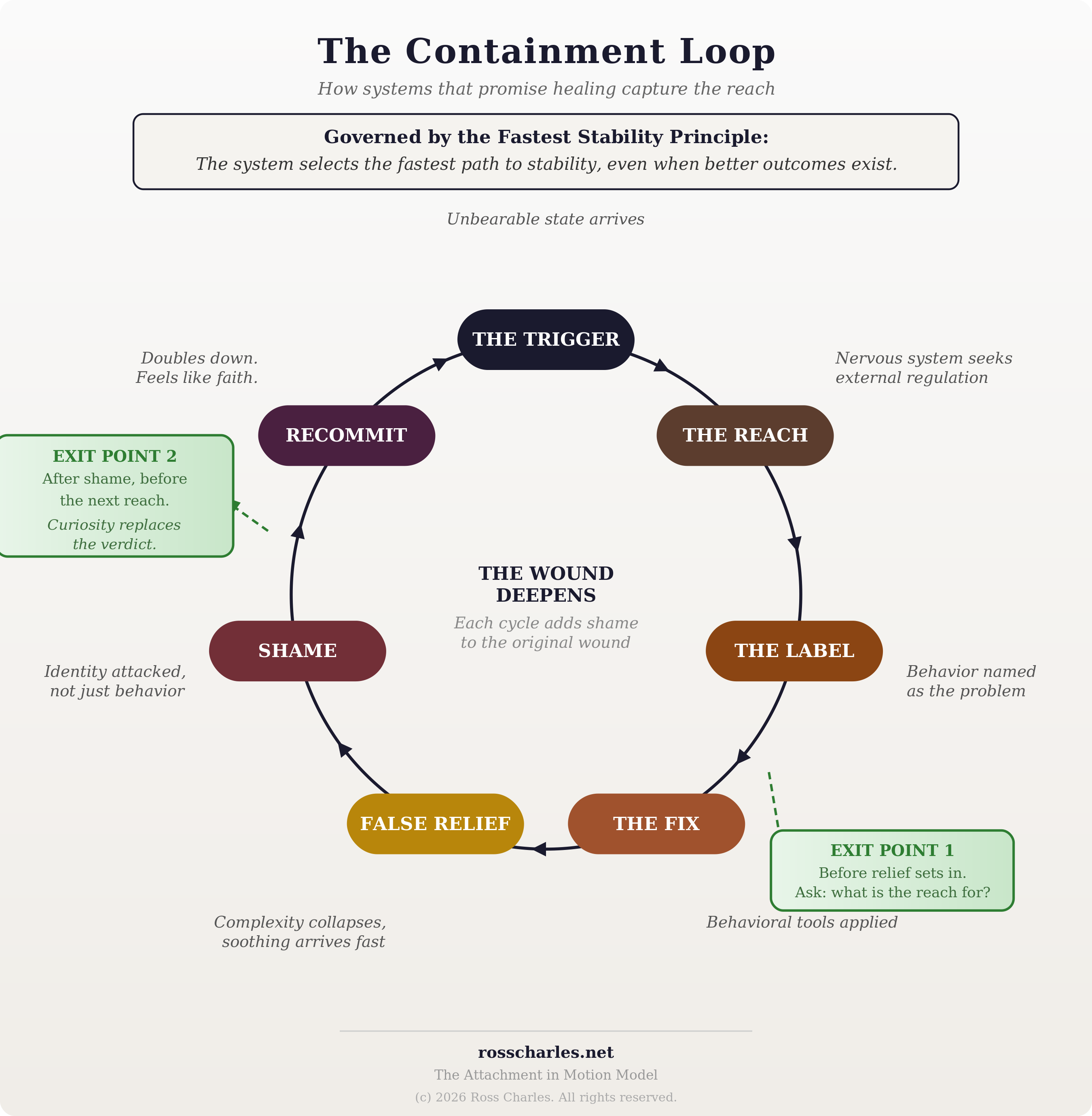
The Containment Loop maps how this happens. Step by step. Not as conspiracy. As mechanism.
Not a layer. A mechanism that operates across all layers.
The five layers of The Attachment in Motion Model describe the architecture: where safety is sourced, what identity the system built, how attachment behaviors express in real time, and how the nervous system replicates its original environment.
The Containment Loop is not a layer. It is the mechanism that explains why a person can understand every layer, do the work, enter the systems designed to help, and still remain stuck. It is the trap that runs underneath the architecture. The thing that makes the wound invisible by making the treatment feel like progress.
Ten steps. One closed loop.
1. The Trigger
Something activates the nervous system. A relational rupture. A failure. A loss. A moment where the body remembers what it has been trying to forget. The system destabilizes.
2. The Reach
The person reaches. Toward a partner, a therapist, a church, a substance, a framework, a group. The reach is not the problem. The reach is the nervous system seeking regulation. This is healthy. This is what it is supposed to do.
3. The System Observes
The system that receives the reach, whatever it is, observes the pain. It sees the activation. It recognizes the need. This is the moment where the path forks. A system that serves the person would help them build internal capacity. A system that captures the person does something different.
4. The Label
The system gives the pain a name. Codependency. Sin. Attachment wound. Toxic pattern. The label is not wrong, necessarily. But the label does something specific: it locates the problem inside the person. Not inside the system. Not inside the environment. Inside the person. The person now owns the diagnosis.
5. The Fix
The system offers a solution. A program. A practice. A protocol. A set of steps. The solution is designed to address the label. It provides structure, language, community, and a sense of progress. The person feels better. The activation decreases. The system appears to be working.
6. False Relief
The person experiences relief. Real, physiological relief. The nervous system settles. But the relief is borrowed. It is sourced from the system, not from the person's own internal capacity. The wound has not been resolved. It has been managed. The regulation is real. The source of the regulation is external.
7. Shame Seeds
When the activation returns, and it always returns because the underlying source has not changed, the person does not question the system. The person questions themselves. The internal narrative shifts: I must not be doing it right. I must not be committed enough. I must be more broken than I thought.
8. Shame Enforces
The shame does not just arrive. It enforces. It prevents the person from questioning the system, because questioning the system would mean the label was wrong, and if the label was wrong, the entire framework of meaning collapses. Shame keeps the person inside the loop by making the exit feel more dangerous than staying.
9. Recommitment
The person recommits. Tries harder. Goes deeper. Attends more sessions. Reads another book. Joins another program. The recommitment feels like faith, like growth, like discipline. It is none of those things. It is the loop closing.
10. The Loop Closes
The person is back at the beginning. The trigger will come again. The reach will happen again. The system will capture it again. The loop is self-sustaining. It does not require malice. It does not require conspiracy. It only requires a system that provides external regulation without building internal capacity.
Shame is not a byproduct. It is the enforcement mechanism.
Shame is not a side effect of the containment loop. It is the mechanism that keeps the loop running. Without shame, the person would question the system after the second or third cycle. They would notice that the relief is temporary. They would notice that the activation keeps returning. They would leave.
Shame prevents that exit. It redirects the evaluation inward. The question stops being "Is this system working?" and becomes "What is wrong with me that I cannot make this system work?"
This is how containment operates across every system that captures the reach:
- In religion: "You are not faithful enough."
- In therapy: "You are not doing the work."
- In self-help: "You are not committed enough."
- In relationships: "You are too much" or "You are not enough."
The language changes. The mechanism does not. Shame turns the person's own pain into proof that they need the system more, not less. The loop tightens. The exit narrows. The wound stays open but invisible, because the treatment has become the container.
The loop, mapped.
Part of a larger architecture.
The Containment Loop is a mechanism within The Attachment in Motion Model, a complete system for understanding where the nervous system sources its safety and what it takes to move the source inside.
On origins, sources, and what is original, see Foundations and Origins.
The Containment Loop is an original framework developed by Ross Charles. Part of The Attachment in Motion Model.