
Part 4 in the series Biblical Manhood as Coping Strategy: How Men Dress Up Coping in Sunday Best and Call It Transformation
Start here: Biblical Manhood as a Coping Strategy series overview
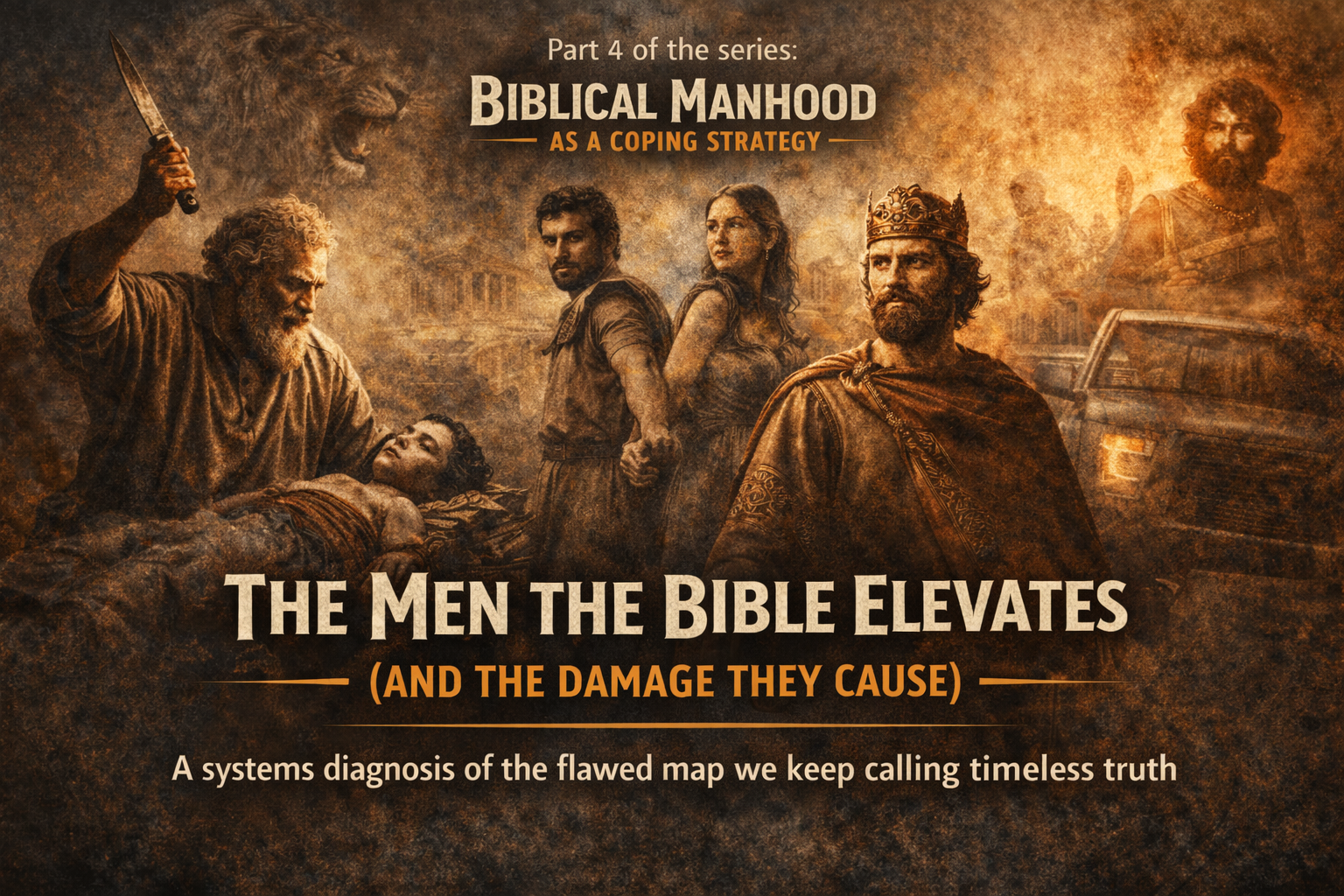
A systems diagnosis of the flawed map we keep calling timeless truth
Up to this point in the series, we have done three things clearly.
We named biblical manhood as a coping strategy dressed in religious authority.
We showed why masculinity tightens under threat.
And we demonstrated that manhood is not timeless. It is contextual, reactive, and shaped by fear.
If we are serious about biblical manhood, the next step is unavoidable.
We have to look at the men in the Bible.
Not the sanitized versions preached from stages.
Not the flattened archetypes turned into leadership lessons.
The actual men. As written. With consequences included.
This is not an attack on faith.
It is a systems reading of the text we keep claiming as a blueprint.
The Bible does not hide the fractures. We do.
There Is No Biblical Definition of Manhood
This needs to be said plainly.
The Bible never gives a single, coherent definition of manhood.
There is no manifesto. No unified model. No divine checklist of what it means to be a man.
Modern teachings assemble fragments.
“Act like men.”
“Husband as head.”
“Be strong.”
“Protect. Provide. Lead.”
But in context, these passages address courage, love, and mutual responsibility within community. They are not prescriptions for rigid gender roles. They are not personality blueprints. They are not nervous-system strategies for suppressing fear.
What we call “biblical manhood” today is a modern construction projected backward onto ancient text.
So instead of abstractions, let’s look at the actual men the Bible elevates.
Abraham: Faithful, Fearful, and Self-Preserving
Abraham is called the father of faith.
He also twice presents his wife Sarah as his sister to protect himself from powerful men.
He trades her safety for his survival.
He walks away wealthier.
She absorbs the risk.
Later, when Sarah cannot conceive, Abraham agrees to impregnate Hagar, her enslaved servant. When conflict follows, he allows Sarah to mistreat Hagar, then sends Hagar and Ishmael into the wilderness with minimal provision.
This is not leadership.
It is hierarchy preserving itself.
From an attachment lens, this is disorganized care. Protection offered sometimes. Abandonment other times. Love tied to utility and inheritance.
From a nervous-system lens, this is threat-based decision making. Fear narrowing options. Self-preservation overriding relational responsibility.
If this is manhood, it does not create safety. It creates instability.
Abraham and Isaac: When Obedience Overrides Attachment
There is no honest discussion of biblical manhood that can avoid Genesis 22.
God tells Abraham to take his son Isaac, bind him, and kill him.
Abraham does not argue.
He does not protest.
He does not protect the child entrusted to him.
He obeys.
The knife is raised. The act is stopped at the last moment.
Most interpretations rush to frame this as faith, trust, or divine testing. But pause and look at it through the only lens that matters to a child.
Isaac is bound by his father.
Placed on an altar.
Prepared for slaughter.
By the man who is supposed to keep him safe.
Even if the blade never falls, the nervous system records the event.
Secure attachment depends on one core truth: the caregiver will not become the threat. Genesis 22 violates that truth completely.
Abraham demonstrates that obedience to authority outranks protection of the child.
Isaac learns something profound in that moment, whether the story names it or not. Safety is conditional. Love can turn lethal. Authority must be appeased.
That is not faith formation.
That is terror encoded as theology.
From a nervous-system perspective, this is overwhelming, inescapable threat. The child has no agency. No voice. No escape. His body learns that survival depends on submission, silence, and compliance.
We are never told how Isaac integrates this.
But the story does not end well.
Later, Isaac appears passive, avoidant, and emotionally muted. His wife Rebekah navigates family conflict without him. His sons Jacob and Esau spiral into rivalry, deception, and estrangement.
Trauma that is spiritualized but not integrated does not disappear. It moves downstream.
What Genesis 22 reveals is not heroic masculinity. It reveals what happens when obedience becomes more sacred than attachment.
And when that story is preached as virtue, the damage multiplies.
Men learn that righteousness means overriding instinct.
That faith means silencing empathy.
That strength means sacrificing intimacy for approval.
Children learn that love is unsafe.
That authority can demand annihilation.
That God may ask for everything, including their life.
This is not abstract theology.
It is the blueprint behind religious trauma.
If this is called manhood, then manhood is built on fear.
The text does not ask us to copy this.
It shows us the cost.
Lot: Righteousness That Sacrifices the Vulnerable
Lot is described as righteous.
When a mob threatens his guests, he offers his daughters instead.
“Do to them what you like.”
After Sodom’s destruction, his daughters intoxicate him and conceive by him to preserve the family line.
The text does not sanitize this. It records it.
Fear dominates. Survival overrides protection. Power flows downward. The vulnerable absorb the cost.
This is not moral strength.
It is collapse management.
David: Desire, Power, and Cascading Damage
David is called a man after God’s heart.
He also takes Bathsheba, then arranges the death of her husband to conceal it.
Later, his household disintegrates.
Sexual violence.
Revenge.
Civil war.
David’s unresolved inner fractures replicate outward.
Authority without integration multiplies harm.
This is not an exception.
It is a pattern.
Jacob, Solomon, and the Pattern Repeats
Jacob manipulates for blessing and favors one son, nearly destroying his family.
Solomon accumulates wives, power, and wealth until his kingdom fractures under its own weight.
Again and again, the text shows the same outcome.
Hierarchy over attunement.
Control over curiosity.
Legacy over relationship.
The Bible records the consequences. It does not endorse the pattern.
God as Father: The Template We Avoid Examining
Any honest discussion of biblical manhood must include the primary Father figure.
The God of the Old Testament is portrayed as loving and protective, and also jealous, punitive, and terrifying.
Commands to sacrifice a child.
Mass destruction through flood.
Total annihilation of enemy populations.
Obedience enforced through fear.
Apologists rush to justify this as divine justice.
But from an attachment and nervous-system perspective, the pattern is clear.
Love is conditional.
Safety is unpredictable.
Power is absolute.
That dynamic creates compliance, not integration.
And it maps cleanly onto modern masculinity frameworks built on vigilance, dominance, obedience, and suppression.
Jesus interrupts this pattern.
But much of what is preached as biblical masculinity today draws far more from the threatening Father than the self-giving Son.
What the Text Is Actually Doing
Here is the critical misread.
The Bible is not offering role models for replication.
It is documenting fractured humans navigating power, fear, inheritance, and survival.
It is descriptive, not prescriptive.
Turning these stories into a timeless manhood framework requires ignoring their outcomes.
And when you do that, the results repeat.
Men become more controlled.
More compliant.
More admired.
And less whole.
Why This Matters
Biblical manhood, as it is currently taught, does not arise from the text.
It arises from fear.
Fear of collapse.
Fear of uncertainty.
Fear of feeling.
Scripture gets recruited to stabilize nervous systems that do not yet feel safe enough to widen.
That produces coping, not healing.
And coping dressed up as transformation always hits a ceiling.
A Different Invitation
If these stories do anything, they invite humility.
Integration, not imitation.
Curiosity, not certainty.
Capacity, not control.
They warn us what happens when power replaces presence.
Manhood does not need to be tougher.
It needs to be wider.
Not more obedient.
More embodied.
Not more certain.
More alive.
Once you see the pattern, it stays visible.
Next, we look at what happens when survival states get labeled sin.
Stay with me if this is landing.
Start here: Biblical Manhood as a Coping Strategy series overview
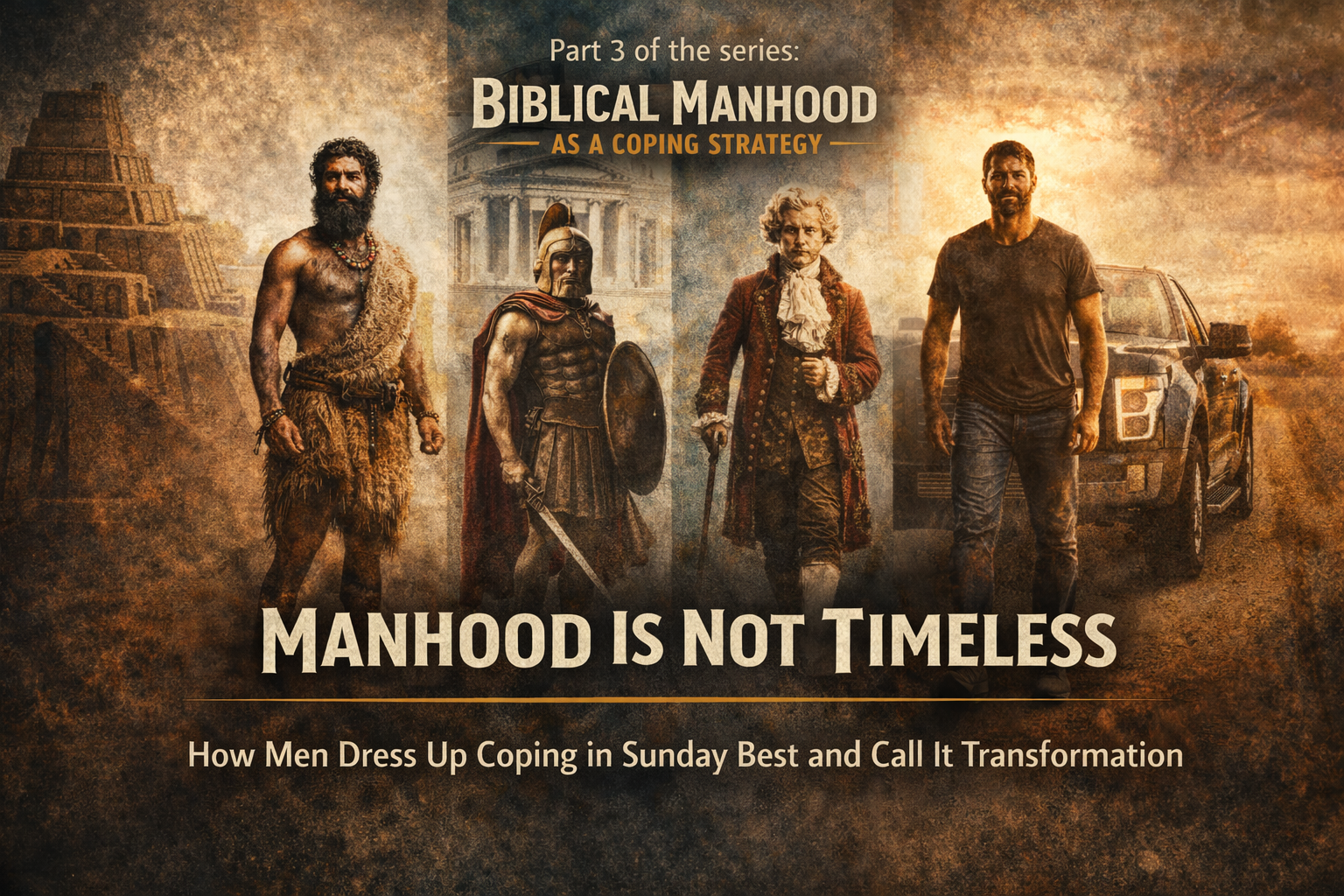
Previous Article: Manhood Is Not Timeless
 7 Jan, 2026