
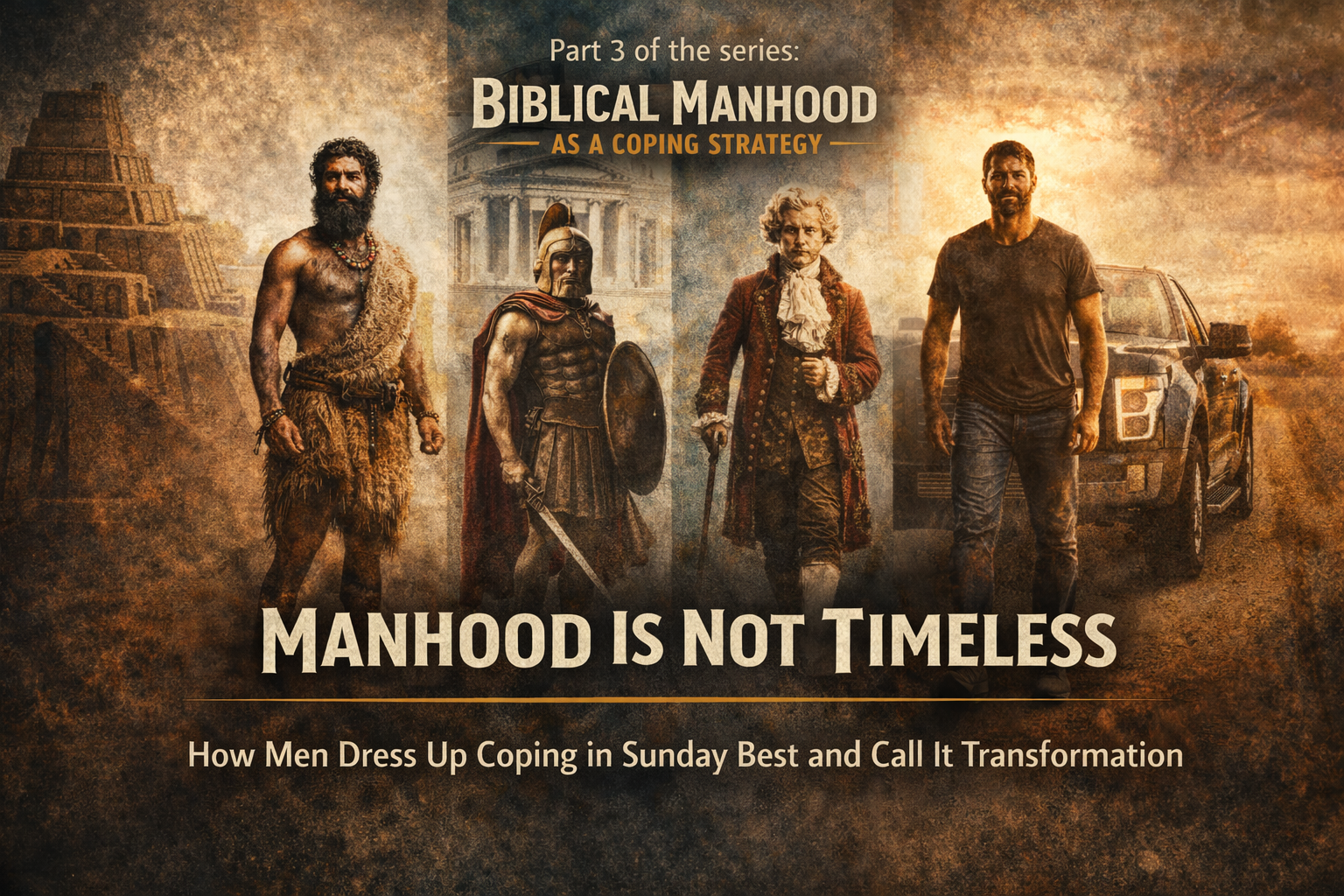

Part 3 in the series Biblical Manhood as Coping Strategy: How Men Dress Up Coping in Sunday Best and Call It Transformation Start here: Biblical Manhood as Coping Strategy series overview
Manhood is not timeless
The idea you have right now of what a real man looks like, acts like, drives like, it’s all made up. Made up by dudes who are alive today. Joby Martin, Mark Driscoll, the pastors pushing the current wave, they tell you manhood is biblical, ancient, God-ordained. Be watchful, stand firm, act like men, be strong. Drive a truck, wear boots, hunt, protect, provide, no excuses, no weakness.
It’s a script. Not eternal truth. Not from God. Just a cultural construct that fits their moment.
To see it clear, let’s go back. Way back. Across millennia. We’ll look at what manhood meant in the Bronze Age, ancient Greece, 18th century Europe. What men believed. What they wore. Then we’ll drop a modern “real man” in there with a time machine. The guy in jeans, boots, beard, driving a truck, no makeup, no frills. See how he’d be perceived.
The point: your version of manhood isn’t special. It’s just the latest idea. Made up to cope with the threats of now. Nothing more.
Bronze Age Manhood: Mesopotamia, Around 3000 BCE
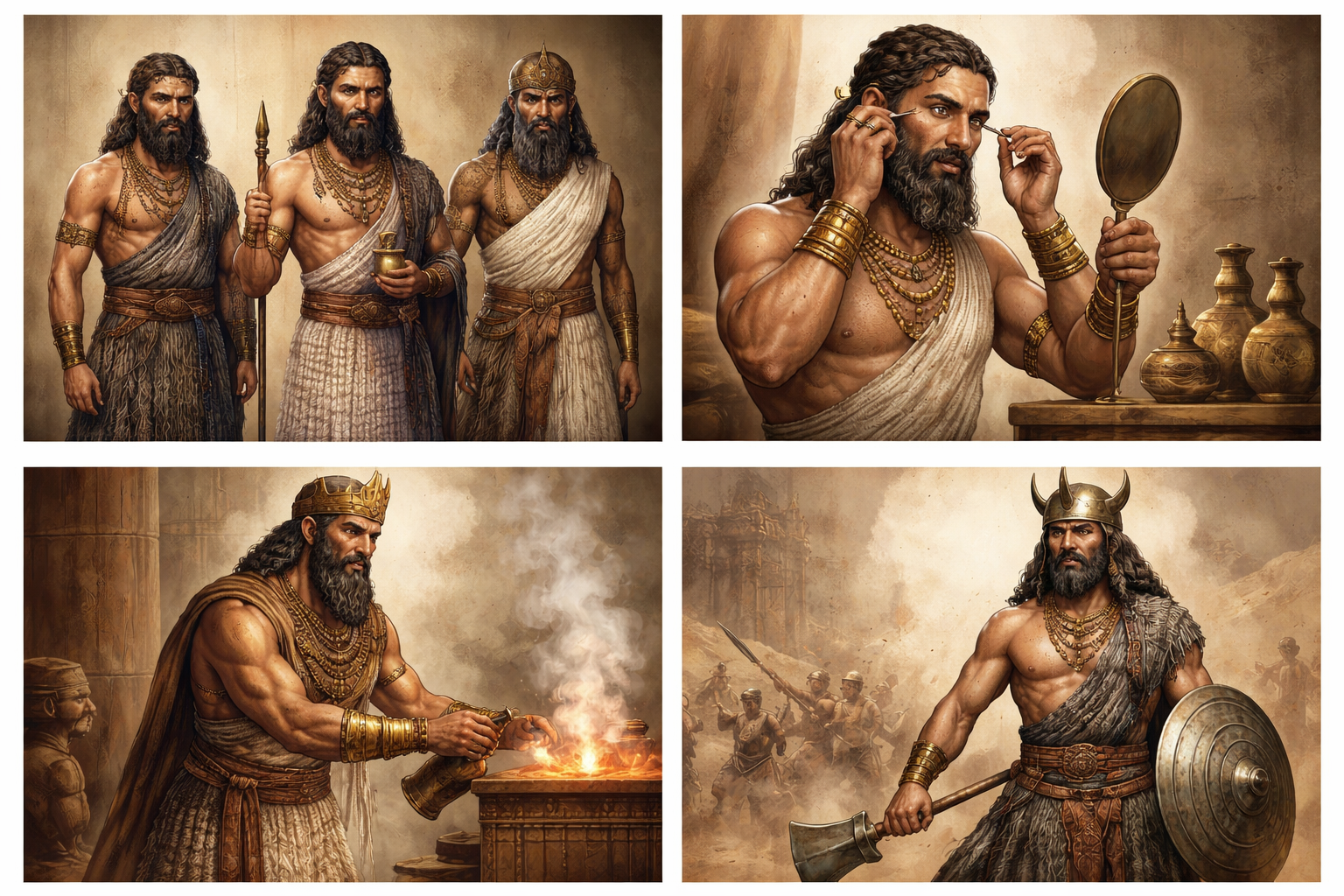
In the Bronze Age, Mesopotamia, manhood was tied to fertility, kingship, divine favor. Men were priests, warriors, farmers. They believed true manhood meant channeling gods’ power, building cities, fathering sons, leading rituals. Strength came from the divine, not individual grit.
What they wore: Kaunakes, fringed wool skirts wrapped around the body. Often bare-chested to show oiled skin, jewelry like necklaces, bracelets, rings. Beards curled and perfumed. Sometimes eye makeup, kohl to ward off evil or enhance status. Loincloths for labor, tunics for kings with elaborate fringes.
Ancient Greek Manhood: Warriors in the Classical Period, 5th-4th Century BCE
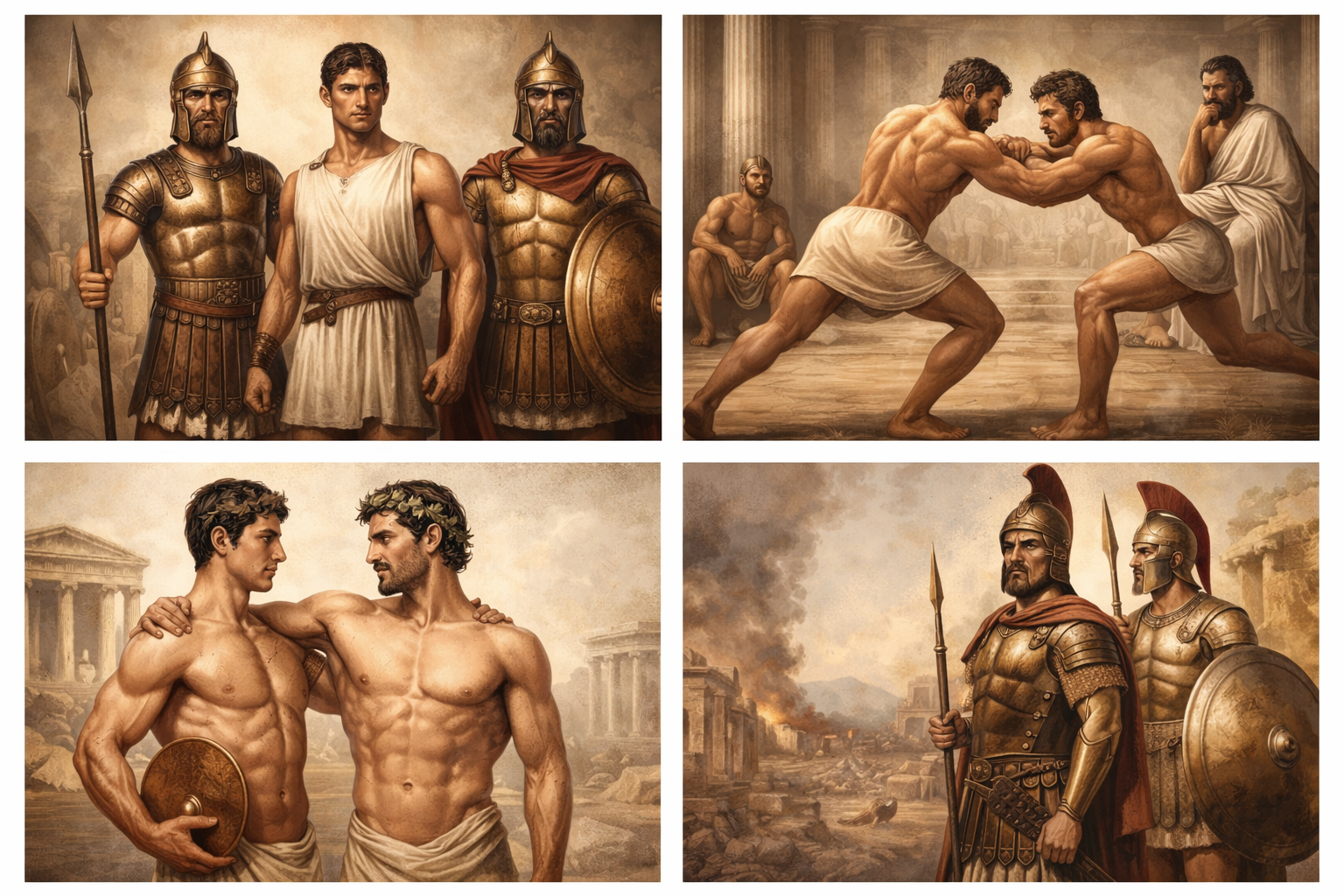
In ancient Greece, manhood meant citizenship, philosophy, war, athletics. Men believed true masculinity was balanced body and mind. Arete, excellence in virtue, strength, courage. Homoerotic bonds between men were normal, mentoring boys into manhood. Gods like Zeus, Apollo modeled it: powerful, beautiful, controlled.
What they wore: Chitons, short tunics to mid-thigh, often bare-chested or nude for athletics. Warriors in linen tunics under bronze armor, oiled bodies gleaming. Beards for older men, clean-shaven youth. No pants, tunics allowed movement. Sandals or bare feet.
Manhood then: excellence, balance, beauty. God-ordained by Zeus? Sure. Timeless? Look at the tunics.
18th Century Europe: Nobility in the Age of Enlightenment
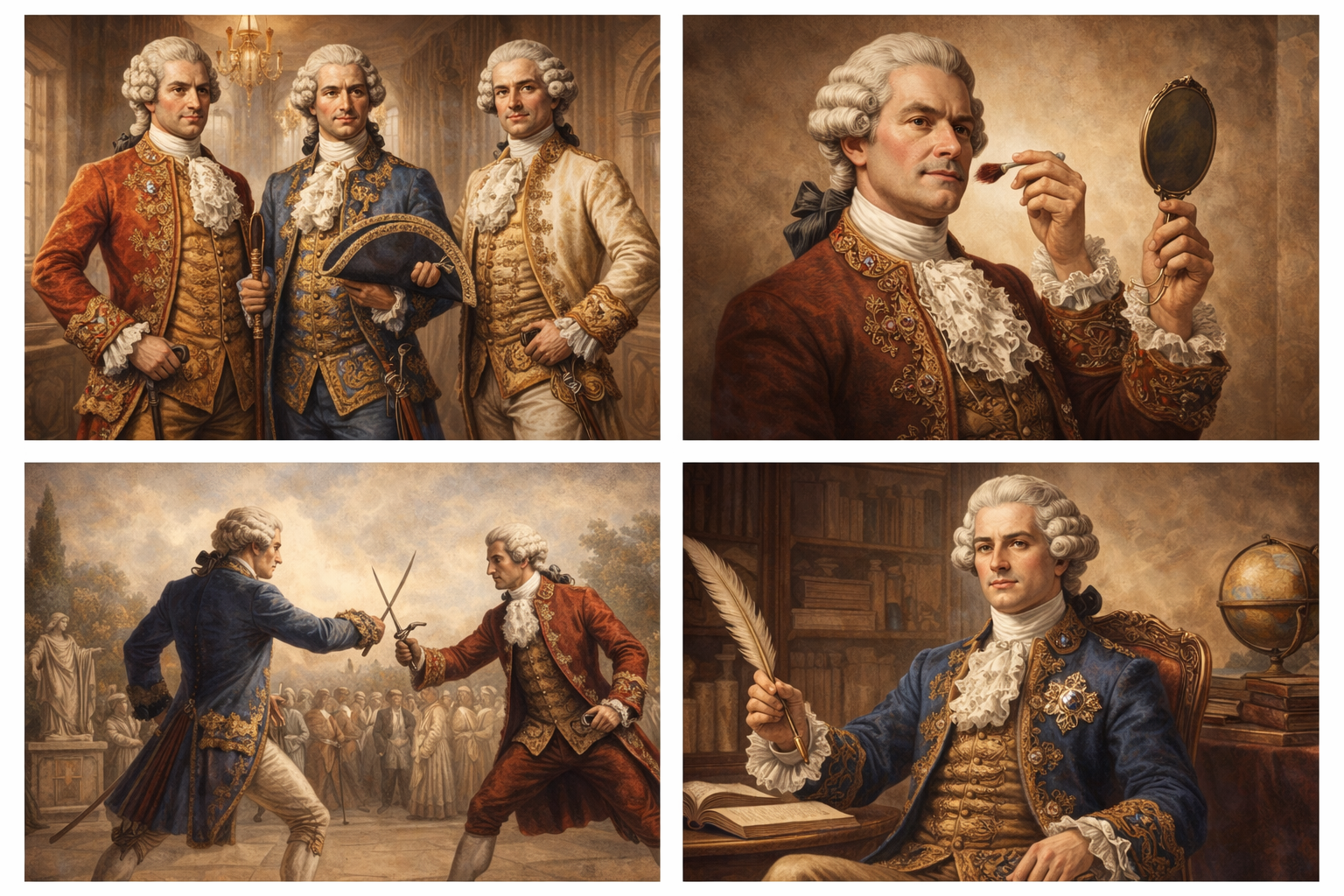
In 18th century Europe, manhood meant refinement, wit, courtly power. Nobles believed true men were educated, gallant, masters of etiquette. Strength in social grace, duels, philosophy. Gods or reason ordained hierarchy, kings divine.
What they wore: Powdered wigs, curled and elaborate. Makeup, rouge on cheeks, powder on face. Silk stockings, heeled shoes, ornate coats with lace, frills, embroidery. Tight breeches, ruffled shirts. Jewelry, swords as accessories.
Manhood then: elegance, adornment, grace. God-ordained by divine kings? Absolutely. Timeless? Try telling that to a powdered noble.
The Larger Truth Coming Into Focus
Look at everything we have seen so far.
In Mesopotamia, real men wore fringed skirts, oiled their bodies, curled their beards, lined their eyes with kohl, loaded themselves with jewelry. That was strength. That was divine favor. That was what God, or the gods, required of a man.
In ancient Greece, real men trained naked, wore short tunics that showed their legs, oiled their skin to shine, balanced body and mind, mentored younger men in ways we would call questionable today. That was excellence. That was virtue. That was manhood as the gods intended.
In 18th century Europe, real men powdered their faces, rouged their cheeks, wore towering wigs, silk stockings, high heels, lace cuffs, embroidered coats. Refinement, grace, courtly power. That was what separated men from beasts. That was civilized manhood, blessed by reason and often by divine right.
Now look at the version sold to you today.
Jeans and boots. Beard but no oil or curls. Truck instead of horse or chariot. No makeup, no jewelry, no adornment. Strength through plainness, endurance, protection, provision. Vulnerability suspect. Emotional range limited. Rest framed as laziness.
If you took that man, the one shaped by Driscoll’s old rants or Martin’s current calls, and dropped him in any of those eras, he would not be celebrated.
He would be judged crude in Mesopotamia. Barbaric in Greece. Vulgar and low-class in Versailles.
And if you took one of those historical men and dropped him in a modern men’s conference, he would face the same.
The wigged aristocrat with rouge and heels? Mocked as effeminate. The Greek warrior in a short tunic? Questioned for showing too much skin. The Bronze Age king in fringes and kohl? Laughed at for the makeup and skirt.
This is the evidence.
Manhood changes. Dramatically. Across time. Across cultures.
What feels timeless to you is only timely.
It is shaped by the threats of the moment. Economic shifts. Social changes. Perceived chaos. The nervous system, under pressure, grabs for order. Culture supplies the script. Pastors and authors package it as biblical.
Biology confirms it. Threat narrows the system. It reduces options. It favors control, clarity, hierarchy. Masculinity becomes the brace the body leans on.
History confirms it. Every era has its version. Every era believes theirs is the true one.
The God claim falls apart here too.
If manhood was divinely fixed, eternally ordained, it would not shift like this. God does not change. But ideas of manhood do. Constantly.
Your version is not special. It is not eternal. It is not from heaven.
It is an idea. Constructed by men alive right now, responding to the fears and needs of this decade.
Driscoll pushed trucks, boots, hunting, no crying, because that fit his world. Martin pushes watchfulness, discipline, groups, because that fits this one.
Both feel profound because they reduce ambiguity. Both feel biblical because scripture gets recruited to back them.
Both are coping strategies. Dressed up. Sold as transformation.
Recognizing this does not destroy faith. It does not destroy manhood.
It opens the door to something freer.
When you see the construct for what it is, you stop needing to defend it. You stop needing to perform it perfectly.
You gain space to ask what safety actually feels like in your body. What strength feels like when it is not organized around threat. What manhood could be when it is not a brace.
That is where healing starts.
Not in tighter rules. In wider range.
Next week we look at how coping states get labeled sin.
Stay with me if this is landing.
Start here: Biblical Manhood as Coping Strategy series overview
Previous Article: Why Biblical Manhood Works (And Why That’s The Problem)
Next Article: The Men The Bible Elevates and The Damage They Cause