
Part 1 in the series Biblical Manhood as a Coping Strategy: How Men Dress Up Coping in Sunday Best and Call It Transformation
Start here: Biblical Manhood as a Coping Strategy series overview
Biblical manhood works.
That statement will upset some people and confuse others, but it has to be said up front if anything else is going to make sense.
It works the same way a brace works on a broken limb. It works the same way rigid structure works in a crisis. It works the same way certainty works when the nervous system is overwhelmed.
It lets men cope.
And that is exactly the problem.
Why “It Works” Is Not a Compliment
When men run into biblical manhood teaching, a lot of them feel an immediate shift. Rules replace ambiguity. Roles replace confusion. Authority replaces uncertainty.
Life feels less chaotic. Decisions feel clearer. Inner conflict quiets down.
This isn’t evidence of healing. It’s evidence of narrowing.
When the nervous system senses threat, it doesn’t expand. It constricts. It cuts options. It chooses certainty over complexity, control over curiosity.
These frameworks succeed because they line up perfectly with that constriction. They don’t resolve dysregulation. They organize it into coping.
Coping Feels Like Strength When You’ve Been Just Getting By
For a body that’s been running on chronic uncertainty, that kind of organization feels like relief.
Suddenly you know what to do. You know who you’re supposed to be. You know what’s expected.
That clarity can feel like strength because it lowers the internal noise.
But lower noise isn’t the same as greater capacity.
A man who feels calmer because he’s following rules isn’t necessarily freer. He may just have less internal argument.
Biblical manhood teaching often calls that lack of argument maturity. It isn’t. It’s a coping adaptation.
Why These Teachings Hit Hurting Men So Hard
These frameworks don’t spread because men are weak or gullible. They spread because they meet men exactly where so many already are.
Most men who land in these teachings are carrying unresolved threat from childhood, emotional neglect, shame-based identity, constant pressure to perform strength without real support, fear of failure, exposure, or collapse.
In that place, freedom isn’t the first thing you want. Predictable coping is.
Biblical manhood teaching delivers predictable coping fast and clean.
It does that by externalizing authority, moralizing internal states, prescribing behavior instead of inquiry, replacing self-attunement with obedience.
That’s not accidental. It’s efficient.
The Five Moves That Make It Stick
The mechanics are consistent across different versions.
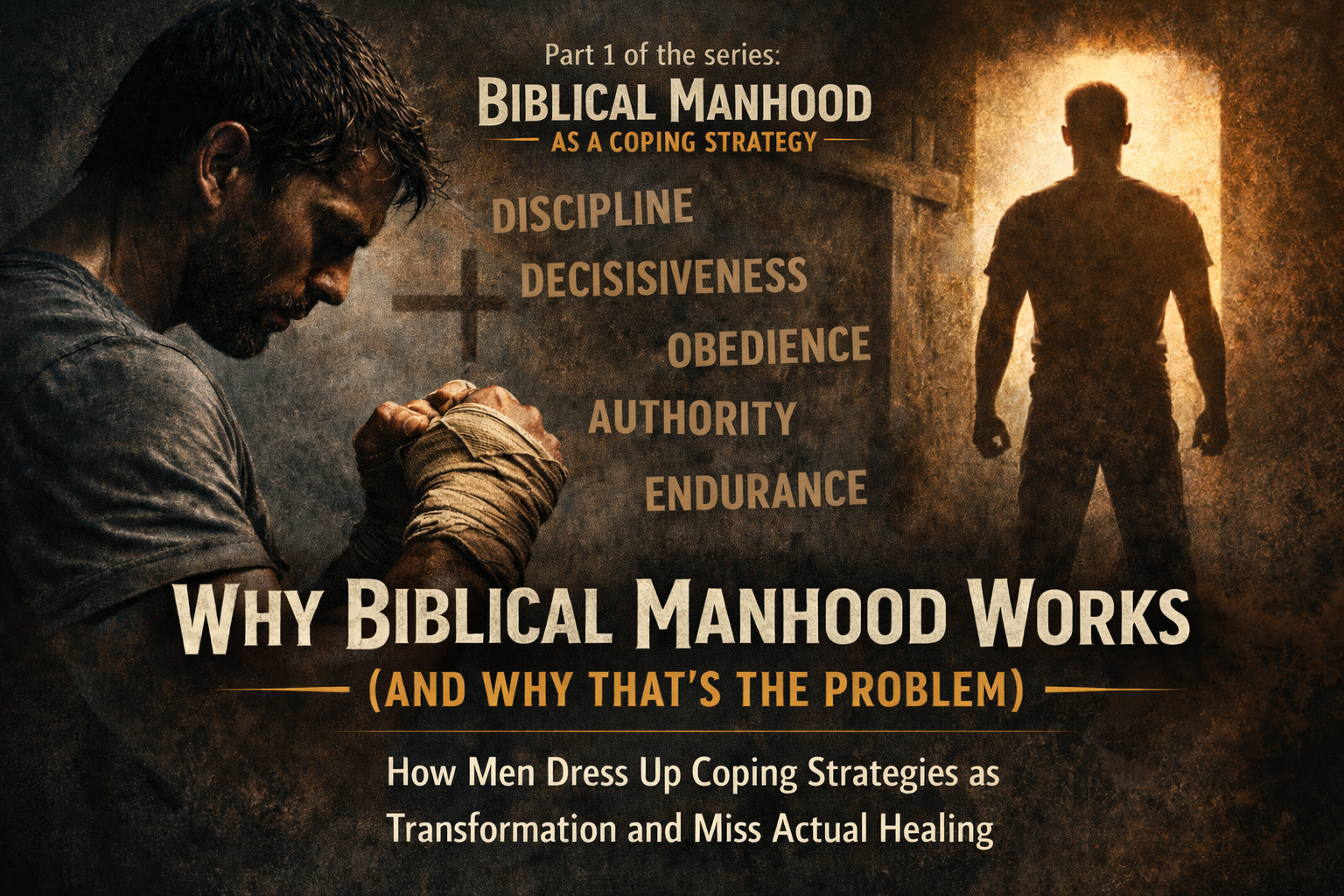
- Define strength narrowly. Strength equals discipline, decisiveness, sexual control, authority, endurance.
- Name internal states as threats. Anxiety, desire, exhaustion, doubt, longing all become dangers to subdue.
- Offer clear prescriptions. Pray more. Submit more. Act faster. Rest less. Question less.
- Provide external reinforcement. Accountability groups. Hierarchies. Role clarity. Moral feedback.
- Call compliance transformation. Visible behavior change gets celebrated as proof of inner change.
Every one of these moves reduces uncertainty. Every one of them also reduces range.
What Gets Lost When Coping Is the Goal
Coping systems always cost something.
They trade flexibility for control. Depth for clarity. Presence for performance. Freedom for function.
A man shaped mainly by coping learns to manage life, not live it fully.
He may look strong, but his system is brittle. He may look disciplined, but his capacity is narrow. He may look confident, but curiosity has been cut off.
This keeps men stuck.
Why Obedience Feels So Good When Coping Is All You Have
Obedience simplifies everything.
You stop having to ask what you feel, what you need, what’s true for you right now.
You only ask what you are supposed to do.
For a nervous system carrying heavy responsibility, shame, or fear, that feels like mercy.
But healing doesn’t come from outsourcing agency.
Healing comes from slowly building the capacity to feel without collapsing, desire without fleeing, rest without shame, choose without compulsion.
Obedience skips that work completely.
Coping Dressed Up Is Not Transcendence
This distinction matters for everything that follows in the series.
Coping is an everyday function. It reduces threat by limiting options.
Transcendence is a growth function. It increases capacity by expanding range.
Biblical manhood teaching is excellent at the first and blocks the second.
It teaches men how to manage themselves under pressure, not how to become more alive.
That’s why it feels so effective. And that’s why it ultimately fails.
Why This Matters
Men don’t heal by becoming more controlled. They heal by becoming more capable.
Capable of holding complexity. Tolerating uncertainty. Staying present with discomfort. Choosing instead of obeying. Resting without justification.
Any framework that equates strength with control will eventually hit a ceiling on that growth.
It will keep men functional, faithful, and often admired. And quietly stuck coping.
Where This Series Is Going
This first piece lays down one truth: biblical manhood works because it lets hurting men cope in religious clothes.
The rest of the series will look at why this wave is surging right now, how masculinity has always been culturally constructed, how coping states get labeled sin, why accountability rarely builds real attachment, why desire and rest get pathologized, and what strength actually looks like when it’s no longer organized around coping.
Names will come up. Teachings will be quoted. Claims will be tested.
Not to stir outrage. To make freedom possible.
Coping isn’t shameful. But it isn’t the destination either.
And any version of manhood that lets men dress up coping in Sunday best and call it transformation will always leave them stuck.
Next part drops next week.
Start here: Biblical Manhood as a Coping Strategy series overview | Next Article: Why Masculinity Tightens Under Threat

 8 Jan, 2026