
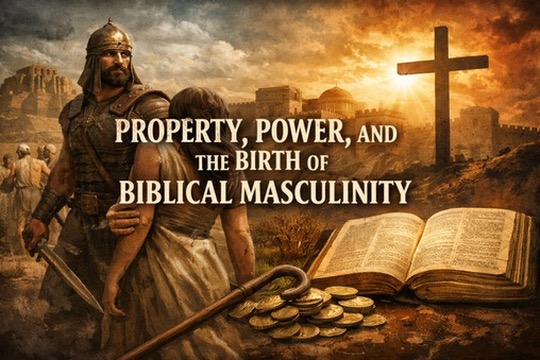

Why certainty sold to suffering men feels good and ruins everything
Men are being offered certainty at the exact moment they need transformation. They are being handed roles instead of repair, hierarchy instead of healing, answers instead of attunement. The people selling it know the effect. You can feel it in the room. Spines straighten. Fear quiets. Belonging clicks into place.
And nothing real changes.
The current wave of Christian masculinity teaching, popularized again by figures like Mark Driscoll and echoed by leaders like Joby Martin, is not a recovery of ancient truth. It is a trauma strategy dressed up as theology.
And we can prove it.
What they teach
Across books, sermons, conferences, and podcasts, the emotional center of gravity is protection. Not curiosity. Not integration. Protection.
The language is consistent and unmistakable, even when phrasing varies:
- Protect your family
- Protect your children
- Protect your name
- Protect your legacy
- Defend what is yours
- Secure your line
This is not a quote list. It is a pattern.
Masculinity is framed as vigilance. The world is dangerous. Culture is hostile. If men soften, everything collapses. Strength becomes synonymous with control. Faith becomes synonymous with enforcement.
That frame feels powerful because it is regulating. Certainty calms the nervous system. Hierarchy reduces cognitive load. Fear gets converted into mission.
But regulation is not healing.
Take Mark Driscoll’s “Act Like a Man,” where he calls men to “rise up, embrace their God-given responsibilities, and live with courage, integrity, and strength.” He critiques modern men as “allergic to work” and in need of “punching life in the mouth,” positioning manhood as a battle against weakness and societal decline. Similarly, Joby Martin’s “Stand Firm and Act Like Men” draws from 1 Corinthians 16:13–14, urging men to be “watchful, stand firm in the faith, act like men, be strong,” while emphasizing roles as providers, protectors, prophets, priests, and kings. Martin warns against laziness and passivity, framing biblical manhood as a combination of strength and love, but rooted in leadership and responsibility to guard against cultural confusion.
These teachings resonate because they tap into real anxieties, but they prescribe control as the cure.
The timeline they never give you
Let’s put dates on this, because dates matter.
- Anatomically modern humans: roughly 300,000 years ago
- Behaviorally modern humans: roughly 100,000 to 70,000 years ago
- Agriculture begins: roughly 10,000 to 12,000 years ago
- Biblical texts emerge: roughly 3,000 years ago
That means over 90 percent of human history happened without farming, without land ownership, without stored surplus, without inheritance systems, without legacy economics, without rigid patriarchy as a governing structure.
For most of our existence, humans lived as hunter-gatherers in small bands, usually 20 to 150 people.
That matters more than theology.
What hunter-gatherer life actually selected for
In those societies:
- Food was gathered daily
- Resources circulated
- Hoarding was punished or mocked
- Leadership was situational, not permanent
- Cooperation mattered more than dominance
- Emotional attunement was a survival skill
A man who tried to dominate the group threatened cohesion. Aggression increased violence risk. Rigid hierarchy fractured trust. Alpha behavior was not admired. It was corrected.
Masculinity was not about being in charge. It was about being useful.
Anthropological studies of contemporary hunter-gatherers, like the Hadza, !Kung, Mbendjele BaYaka, and Agta, show remarkable gender equality in work and decision-making. Women often hunted alongside men, contributing significantly to big-game pursuits in up to 79% of surveyed societies. Roles were fluid, with both sexes sharing foraging, child-rearing, and leadership based on skill rather than gender. Dominance hierarchies were minimal, and alliances between women helped prevent male domination.
The single move that changed everything
Around ten to twelve thousand years ago, something radical happened.
Someone looked at animals or land and said, effectively:
“See those goats over there? I am going to build an enclosure, put them inside it, and they will be mine.”
That sentence created the modern world.
Once humans stopped following food and started containing it, everything reorganized.
Now there was surplus.
Now there was ownership.
Now there was inequality.
Now there was something to lose.
Agriculture intensified property systems, leading to patrilineal inheritance, polygamy, and stricter control over women’s roles to ensure paternity and legacy. This shift fostered patriarchy, as economic inequality and resource clumping demanded rigid structures.
What ownership immediately creates
The moment surplus exists, three anxieties appear across cultures, every time.
- Legacy anxiety
I now have property to pass on. What happens to this when I die? Did my life amount to something? - Paternity anxiety
Who are my heirs? Are these children mine? - Control anxiety
How do I guarantee continuity? How do I prevent loss?
This is not religion yet. This is fear management.
Religion arrives later to stabilize it.
Why women became property
Here is the uncomfortable causal chain that most masculinity teaching avoids.
Once inheritance matters, paternity matters.
Once paternity matters, ambiguity becomes dangerous.
Before agriculture, child-rearing was cooperative. Humans evolved as cooperative breeders. Children belonged to the group more than to a nuclear couple. Male investment was distributed through kinship, reputation, and cooperation, not ownership. Strict paternity certainty was often socially irrelevant.
In some cultures, paternity was even understood as shared. Multiple men could be considered contributors to a child, which expanded protection and provisioning and reduced male rivalry. The outcome mattered more than biological precision.
Ambiguity strengthened the tribe.
After agriculture, ambiguity became a threat.
So systems responded predictably:
- Female sexuality was controlled
- Marriage became an exchange
- Women were enclosed like land and animals
- Adultery became a crime
- Masculinity became enforcement
This was not because men discovered divine order. It was because property systems cannot tolerate uncertainty.
Women were not subordinated because of timeless truth. They were subordinated because inheritance required control.
Evidence from ethnographic studies shows that pastoralism and farming amplified these dynamics, treating women as property to manage fertility and ensure patrilineal transfer.
Bronze Age masculinity is not eternal masculinity
What gets marketed today as biblical masculinity is best understood as a Bronze Age property protection strategy.
It required:
- Male dominance
- Female submission
- Sexual regulation
- Violence as deterrence
- Othering anyone who threatened the structure
It worked once, in a narrow context, to stabilize ownership systems.
That does not make it sacred. It makes it contingent.
Religion did not invent this masculinity. Religion sanctified it.
Why this exact masculinity keeps resurfacing
Because fear keeps resurfacing.
Every time societies experience instability, this same script returns. Industrialization. Post-war trauma. Civil rights. Feminism. Economic precarity. Cultural fragmentation.
The language shifts. The nervous system mechanics do not.
Trauma looks for authority.
Anxiety looks for rules.
Dysregulation looks for someone in charge.
These movements do not spread because they are true. They spread because they are calming.
The repeating pattern (last ~100 years)
This teaching has resurfaced in recognizable waves at least six times in the last century, usually during periods of social upheaval, identity threat, or masculine dislocation. Each time it uses new language, but the underlying mechanics are identical.
It is not original.
It is reliably reproducible.
Below is not theology. It is pattern recognition.
1. Early 1900s – Muscular Christianity
Industrialization disrupts male identity. Men move from farms to factories. Churches panic about “soft men.”
Response: Jesus framed as strong, virile, warrior-like. Masculinity tied to discipline, authority, conquest. Physical strength moralized.
Same move: anxiety to strength ideology to belonging.
2. 1950s – Post-war patriarchal restoration
Men return from war traumatized. Women have tasted autonomy. Social order feels unstable.
Response: Rigid nuclear family roles. Male breadwinner as moral anchor. Female submission normalized again.
Same move: trauma to hierarchy to certainty.
3. 1970s-80s – Promise Keepers and evangelical men’s movements
Feminism rises. Divorce rates rise. Men feel displaced and confused.
Response: Male headship language. “Spiritual leadership” framing. Emotional expression allowed only within obedience.
Same move: fear to authority to ritualized belonging.
4. 1990s-2000s – Wild at Heart and mythic masculinity
Corporate life drains meaning. Men feel dead inside.
Response: Warrior archetypes. Adventure-as-healing. Avoidance of inner work framed as authenticity.
Same move: dysregulation to archetype to identity costume.
5. 2000s-2010s – Neo-Reformed masculinity
Culture wars intensify. Sexual norms shift rapidly.
Response: Theological certainty. Gender hierarchy reasserted. Submission framed as obedience to God, not men.
Same move: chaos to moral rigidity to power consolidation.
6. 2015-present – Culture-war and red-pill masculinity ecosystems
Economic precarity, loneliness, social fragmentation – both inside and outside the church.
Response: Hyper-dominance language. Alpha frameworks. Contempt for vulnerability. Enemy creation.
Same move: isolation to hierarchy to tribe.
Why it is always so easy to build
Because you are not building belief.
You are building belonging.
Men do not join these movements because they are convinced.
They join because they are relieved.
These systems offer:
clear rules
instant identity
shared enemy
permission to stop feeling
a place to stand
That is incredibly regulating for an anxious nervous system.
As someone who grew up inside this, I know how easy it would be. I could build a following on this belief system tomorrow. Not because I would be particularly persuasive – but because the need already exists.
Men crave belonging.
More precisely: men crave co-regulation without vulnerability.
These frameworks promise connection without exposure, brotherhood without intimacy, purpose without self-examination, strength without integration.
Belonging without vulnerability.
Brotherhood without intimacy.
Purpose without self-knowledge.
Cheap regulation scales.
That is why they spread so easily.
Why the hard path is the real threat
The difficult thing – the truly subversive thing – is to learn about myself, my body, and why I regulate the way I do.
That path removes external enemies, dissolves borrowed identity, collapses hierarchy, requires uncertainty, and demands self-contact.
There is no instant tribe there.
No instant authority.
No applause.
No script.
Just awareness.
And that terrifies unintegrated systems.
You can hear the legacy panic in their voices
Listen closely to how modern masculinity preachers speak.
The emotional fuel is not peace. It is urgency.
Protect your kids.
Protect your legacy.
Protect your name.
Defend what is yours.
This is not spiritual language. It is property anxiety translated into moral urgency.
The subtext is always the same:
“If you fail, everything collapses.
If you soften, chaos wins.
If you question, your children are at risk.
If you let go, your life meant nothing.”
That is not discipleship.
That is terror with a mission statement.
Why women have to be subordinated for this to work
Because autonomous women destabilize fragile male identity built on legacy.
A woman with agency cannot be owned.
She cannot guarantee status.
She cannot stabilize ego.
So the system must rank her, diminish her, spiritualize her submission, and moralize her containment.
This is not about love or care. It is about control.
Regulation is not integration
Hierarchy can reduce anxiety by outsourcing regulation to authority. That feels like strength. It is dependency.
Neuroscience is clear. Healing comes from safety, attunement, emotional completion, flexibility, and embodied self-awareness.
Control suppresses symptoms.
Integration transforms systems.
This is why men can feel powerful in the room and collapse at home.
The hardest test case and why it matters
If this framework explains masculinity and hierarchy, it must also explain why societies panic about sex and gender variance.
Across many hunter-gatherer and small-scale societies, same-sex behavior and gender variance existed without moral panic. Sometimes integrated. Sometimes honored. Rarely treated as an existential threat.
As hierarchy, property, and inheritance intensified, repression intensified. Sex and gender became economic variables. Difference became danger.
Variance is not the problem. Anxiety is.
When nervous systems are regulated by belonging and cooperation, difference is survivable. When nervous systems are regulated by control and hierarchy, difference becomes intolerable.
That pattern holds.
Why scripture cannot save this system
I am not interested in debating verses from the Bible. Closed-loop authority systems are immune to outcomes. They can justify anything.
I am interested in results.
Any framework that requires fear, suppression, or subjugation to function has already failed, regardless of the texts used to defend it.
The quiet danger
Many men feel better under this teaching.
That is real.
And that is the danger.
Relief is not resolution. Regulation is not integration. Survival strategies do not become sacred because they work for a while.
The refusal
I could build a following on this belief system. Anyone who grew up inside it knows how easy it is. Men crave belonging. Certainty sells. Hierarchy scales.
The harder path is learning your body. Understanding your regulation. Letting go of borrowed authority. Facing ambiguity without outsourcing yourself to a system that promises safety and delivers a cage.
Healing does not require harder men.
It requires whole ones.
Wholeness has never needed hierarchy to exist.
If this article makes you feel like your brain just cracked open, good. That is what happens when incentives get exposed.
This is not an attack on faith.
It is an exposure of a system that converts suffering into certainty and calls it care.
And once you see the engine, you cannot unsee it.